Tennessee's NP rules, seen from the student side
The Tennessee nurse practitioner who teaches you works inside a layered state framework: an APRN certificate from the Board of Nursing, a certificate of fitness to prescribe, and a standing arrangement with a collaborating physician. Understanding those layers explains much of what you will watch happen in clinic, and why UofM cares about your preceptor's credentials.
Get your placement plan
Tell us your UofM program and where you live. A placement advisor replies with the preceptor and site options that fit your UofM course.
The board that sets the frame
Advanced practice in Tennessee runs through the Tennessee Board of Nursing, one of the health-related boards housed in the state Department of Health. The governor appoints its 11 members: nine registered nurses or APRNs, one licensed practical nurse and one consumer member. They meet quarterly.
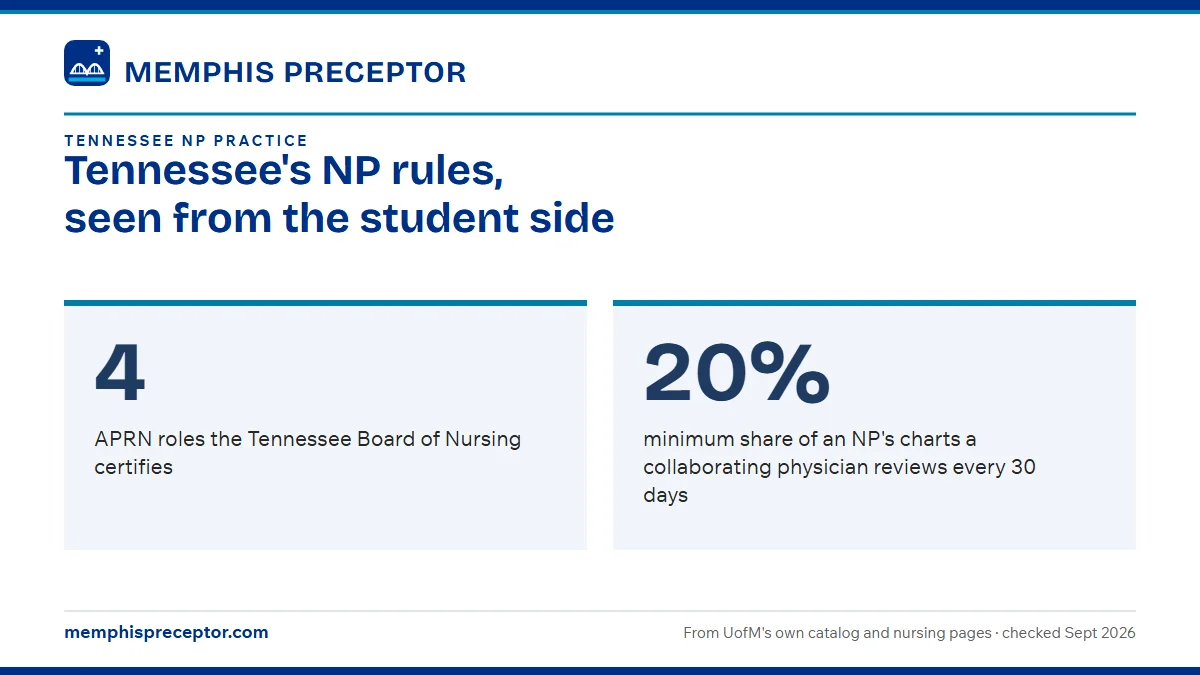
Four advanced roles come under its certification: the nurse practitioner, the certified nurse-midwife, the clinical nurse specialist and the nurse anesthetist, and a certificate can be issued with prescribing authority or without it. It also writes the minimum curriculum rules that every nursing program in the state follows, online delivery included, and reviews school approval each year. On its February 2026 school list, UofM's MSN tracks and post-master's certificates carry full approval.
Two credentials behind every NP who prescribes
The base layer is the APRN certificate. To hold one, a nurse needs RN licensure in good standing, either a Tennessee license or practice rights under a multistate license from another compact state, plus graduate nursing preparation at the master's level or beyond in a specialty and current national certification.
The certificate of fitness sits on top. It is what allows an NP to diagnose, build a medical plan of care and write prescriptions, and it asks for graduate NP preparation that includes a minimum of three quarter hours of pharmacology, along with national certification. Before prescribing, the NP files a notice with the board that names a collaborating physician and attaches a formulary, then keeps it current by filing any change within 30 days.
For you, that means the preceptor diagnosing and prescribing in front of you does so under a notice the board keeps on file, tied to a specific physician.
Physician collaboration, day to day
The AANP counts Tennessee among its restricted practice states, and collaboration is the reason. The Board of Medical Examiners rule has the physician and NP draft protocols jointly and revisit them every two years. The physician stays available for consultation around the clock, and every 30 days reviews no fewer than one chart in five, with remote practice sites visited on the same monthly rhythm.
A 2022 update lets the chart reviews happen electronically, along with up to ten of each year's remote-site visits. The state places no ceiling on how many APRNs a single physician may supervise. In 2024, proposals to release experienced psychiatric NPs from collaboration failed, so the arrangement still applies across every specialty, PMHNP included.
In clinic you may see this machinery firsthand: protocols in a shared binder or system, charts pulled for review, a physician reachable for a quick consult.
What the state expects of a preceptor
Tennessee's nursing education rules treat the preceptor as a partner to faculty, never a replacement. Every clinical experience a student has, precepted ones included, is directed by nursing faculty; the preceptor adds hands-on teaching within that plan. At UofM, that direction comes from clinical faculty, who approve your schedule and conduct the final clinical visit.
The rule also sets a floor for the preceptor's own credentials. They must demonstrate competence in their clinical area, and their license has to be unencumbered, valid in the jurisdiction where they teach, and pitched at your intended role or above it. Schools watch those licenses through Nursys e-Notify. On who arranges the preceptor, the state rules stay silent.
UofM adds its own layer, starting with a nurse practitioner preceptor for at least one rotation in every NP track. Our rotation rules guide lists the rest.
Licenses across state lines
Tennessee joined the multistate Nurse Licensure Compact, whose membership the board's 2025 annual report puts at 43 jurisdictions. Mississippi and Arkansas belong too, which matters for UofM students who live in DeSoto County, West Memphis and the other suburbs across the river and the state line. Holding a multistate RN license, you can practice as a registered nurse across every member state.
The compact stops at RN licensure. An NP precepting you in Mississippi or Arkansas practices under that state's own APRN rules, and Tennessee's preceptor rule looks to the license held where the teaching happens. UofM asks for an unrestricted RN license in Tennessee or in an approved state where your clinicals take place; the RN license guide covers the specifics.
The out-of-state moratorium, and why UofM is outside it
In 2026, Tennessee lawmakers took up a bill filed as SB 2013 and HB 1905. Under its text, the Board of Nursing would spend two years declining to take up or grant applications from nursing schools whose home is in another state, where those schools want permission to teach, recruit or place clinical students within Tennessee.
The bill carves out any program based in Tennessee, defined as one with a physical campus or facility in the state and at least three full-time, on-site, licensed nursing faculty. UofM teaches nursing on its Memphis and Lambuth campuses, so the pause is aimed at programs headquartered elsewhere, and UofM's Tennessee placements continue under its existing board approval.
Programs from other states that were approved earlier keep that approval, though the bill lets the board request reports from them, down to who precepts their students and where those students are placed. For the law's current status, check with the Board of Nursing.
Finding a Tennessee preceptor who fits
Our searches run statewide and across the Memphis metro's state lines. For each candidate, your placement advisor confirms an unencumbered license, a current certificate of fitness for NP preceptors, and a setting that suits your UofM course before those details go into your agreement file.
The regional guides go deeper: Memphis and Shelby County, Jackson and West Tennessee, Nashville and Middle Tennessee, and Knoxville, Chattanooga and East Tennessee. For the statewide picture, start with our Tennessee guide.
Questions UofM students ask
Can a physician precept a UofM NP student in Tennessee?
Tennessee's rule looks at the preceptor's license level, which has to sit at the student's future role or higher, along with competence in the clinical area. UofM adds that at least one rotation in each NP track must be precepted by a nurse practitioner. Beyond that, your clinical faculty confirm which clinicians your course accepts, and we match candidates to that standard.
Do Tennessee NPs need a physician to practice?
Those who prescribe do. The AANP classifies Tennessee as restricted, because NPs with prescribing authority work under a collaborating physician's protocols, chart reviews and consultation rules. Efforts in 2024 to lift the requirement for experienced psychiatric NPs failed. For a student, the effect is a practice where the physician partnership is part of ordinary NP work.
Does the Nurse Licensure Compact cover APRN practice?
The compact covers RN licensure. In Tennessee, advanced practice runs through a separate APRN certificate and, for prescribing, a certificate of fitness, both issued by the Board of Nursing. A multistate RN license helps a UofM student living in a neighboring compact state, but a preceptor's authority to practice as an NP comes from their own state.
Does Tennessee's moratorium affect UofM students?
As written, the moratorium targets nursing programs based in other states that want the board's approval to teach, recruit or place clinical students in Tennessee. A program with a Tennessee campus and at least three full-time on-site licensed nursing faculty is exempt. UofM is based in Memphis, so its students sit outside the pause.
Why do the preceptor's license and certification details matter?
Tennessee expects a preceptor whose license, in the state where they teach, matches or exceeds the student's goal, and schools keep watch on those licenses. UofM's preceptor agreement form must be approved by the Office of Community Partnerships and Practice before your first clinical day, so accurate license and certification details keep that review on track. We gather them for you.
Related pages
Last checked 2026-09-27
We check these pages against UofM's 2026-27 catalog, the LCON Academic Bulletin, program pages and licensure disclosures. Your clinical faculty and your plan of study have the final word.
Whether UofM helps or you start alone, we find the preceptor.
Tell us your UofM concentration, your next practicum and the town you train near. We find preceptors and sites that fit the course and prepare what the preceptor agreement form needs, early enough for approval before the first clinical day.
- Preceptors matched to the rotation rules: an NP preceptor, family practice for FNP, inpatient and critical care for AG-ACNP
- License, certification and site details ready for the preceptor agreement form, with your Complio items in order
- Across the Mid-South, Tennessee and the states UofM serves
Start your placement plan
Your concentration, your town and your next clinical semester is all we need to begin.