Where UofM's online nursing programs are authorized
California is the one settled answer: the Loewenberg College of Nursing is not authorized to offer distance education there. Past California, UofM's pages disagree, with the partnerships office naming 16 authorized states while the licensure disclosures mark every other state as meeting requirements. If you live outside Tennessee, get your state confirmed by LCON in writing before you apply.
Get your placement plan
Tell us your UofM program and where you live. A placement advisor replies with the preceptor and site options that fit your UofM course.
Four UofM sources, four different maps
UofM publishes state information in four places, each written for a different purpose, and side by side they draw different maps. Because MSN practicums happen where you live, the question decides whether your local-area clinicals can run at all.
| UofM source | What it says | What it actually covers |
|---|---|---|
| LCON Residency Requirements page (graduate) | Applicants must live in a state where LCON is authorized to provide distance education; California is excluded | Who may enroll in the online and hybrid nursing programs |
| Office of Community Partnerships and Practice page | Names 16 states where LCON is currently authorized to offer its programs | The college's own list of authorized states |
| UofM Global accreditation page | UofM serves students outside Tennessee through NC-SARA; 49 member states, California excluded | University-wide distance education authority |
| Licensure disclosures, MSN and graduate certificate | FNP, AG-ACNP and PMHNP marked "Meets Requirements: Yes" for the other 49 states and DC | Whether the curriculum fits each state's APRN licensing rules |
The partnerships office list is the narrowest source and the most specific about the college's own programs. The disclosures answer a licensing question rather than a training question, so a "Yes" there does not by itself open a state for clinicals.
California: the one state every source settles
LCON's graduate Residency Requirements page is direct: "The Loewenberg College of Nursing is NOT authorized to offer distance education in California." Applicants to the online and hybrid programs must reside in a state where the college holds authorization, and California is named as the exception.
The same page deals with students who move once enrolled. Students who relocate to California "will be required to fulfill their remaining course requirements in Tennessee or another authorized state, or to withdraw from the program." The RN to BSN page applies the same limit to undergraduates, since California residents cannot enroll there either.
California's own rules point the same way. California regulation 16 CCR 1486 requires a non-California NP program to secure the Board of Registered Nursing's approval before its students train in the state, and each student there must hold a California RN license. UofM was absent from the BRN's list of approved out-of-state NP programs when it was read on 2026-09-27. The California guide has the state's full rules.
A California RN license satisfies California's licensing rule, but it leaves UofM's lack of authorization there unchanged.
The 16 states on the partnerships office list
The Office of Community Partnerships and Practice lists the states where LCON says it is currently authorized to offer its programs. Each of those states still decides how it treats programs from elsewhere that hold clinicals inside its borders. The right-hand column summarizes those board rules, and each state guide carries the detail and the source.
| State | Board rule for out-of-state graduate programs (summary) |
|---|---|
| Tennessee | Home state; the Tennessee Board of Nursing approves and regulates UofM's programs |
| Arkansas | No board rule found for clinical-only placements by out-of-state programs |
| Colorado | No provision found for out-of-state graduate placements |
| Connecticut | Treated as approved when approved at home; ratio and contract rules apply |
| Florida | The rule found covers pre-licensure programs only |
| Georgia | Post-licensure and APRN programs not regulated; Georgia or multistate license needed |
| Kentucky | Board approval not required |
| Mississippi | Higher-education board (IHL) review, requested four months ahead |
| Nebraska | Post-licensure and APRN programs not regulated |
| Nevada | Board approval before distance-program clinicals (NAC 632.703) |
| North Carolina | Board has no jurisdiction over post-licensure graduate programs |
| Oklahoma | APRN students may be precepted without board permission under set conditions |
| South Carolina | Pre-licensure rules only; APRN placements not addressed |
| Texas | Board rules cover pre-licensure only; LCON adds a Texas Education Code Chapter 132 note |
| Utah | Approval required for all programs (R156-31b-609) |
| Wyoming | Written notice to the board and a facility contract first |
Where a board requires approval or notice, that step belongs to the program, not to you. Ask LCON whether it is done for your track, and allow for lead times such as Mississippi's.
Reading the licensure disclosures correctly
UofM's professional licensure disclosures for the MSN and the graduate certificate answer one question: whether the FNP, AG-ACNP or PMHNP curriculum meets a state's requirements for APRN licensure. They mark "Yes" for all 49 other states and DC. Tennessee, the home state, has no row.
California carries the note "Must hold CA RN license", and Hawaii points graduates to licensure by endorsement. The footer adds that board-certified graduates may seek an APRN license wherever they intend to practice.
What the disclosures leave open is where you may enroll and train. UofM Global cautions that programs "may not meet requirements in other states or U.S. territories", and the LCON residency page puts the licensing check on the student: out-of-state students in programs leading to advanced licensure are "individually responsible for verifying that the program meets the requirements for advanced licensure in their state."
How to confirm your state before you apply
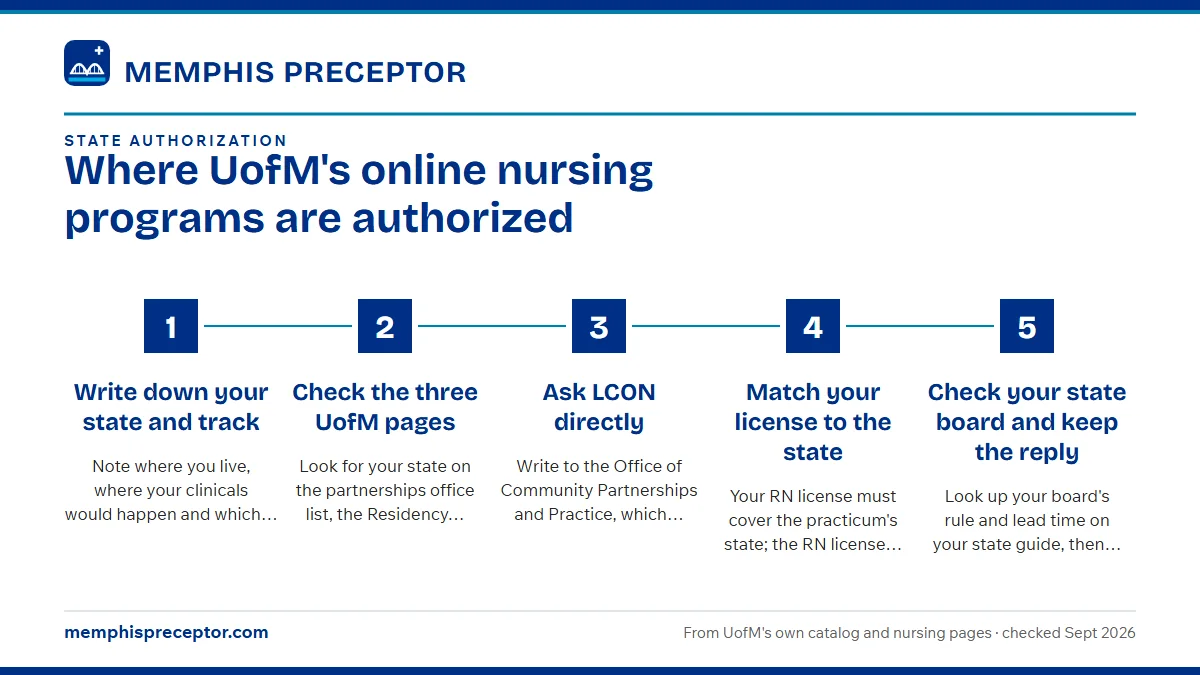
If you live outside Tennessee, treat the conflict as a question to settle on paper. A few short steps protect months of coursework.
- Write down your state and trackNote where you live, where your clinicals would happen and which concentration or certificate you want. The answer can differ by track.
- Check the three UofM pagesLook for your state on the partnerships office list, the Residency Requirements page and the licensure disclosure for your program.
- Ask LCON directlyWrite to the Office of Community Partnerships and Practice, which publishes the state list, and copy the Student Academic Coordinator for Graduate Programs. Ask whether LCON is authorized in your state for your track's clinicals.
- Match your license to the stateYour RN license must cover the practicum's state; the RN license guide explains the compact.
- Check your state board and keep the replyLook up your board's rule and lead time on your state guide, then file LCON's written answer with your admission records.
Moving during the program
A move changes the state your clinicals run in, so raise it with LCON and your Faculty Advisor before you sign a lease rather than after. California is the one move UofM answers in print: finish in Tennessee or another authorized state, or withdraw.
For any other state, ask the questions a new applicant would. Is the new state on the partnerships office list? Does its board expect approval or notice from UofM, and with how much lead time? Does your RN license cover it, or do you need a multistate license or a new one?
Timing matters too. A move between practicum courses leaves room to line up a new site, while a move mid-course means changing sites partway through, which needs written approval from your clinical faculty and the clinical coordinator.
Where we fit: your state comes first
Every search we run for a UofM student starts with geography. Whatever role UofM plays in your placement, we deliver a preceptor and site built to its rules, and rule one is a site in a state where LCON may hold your clinicals.
- We check your state against the partnerships office list and your board's rules before contacting a single preceptor.
- We note any lead time a board sets, such as Mississippi's review window, so the search runs on the right calendar.
- We confirm your license covers the site's state and that your preceptor is licensed there too.
- We prepare the preceptor agreement form details and line up your Complio and myClinicalExchange items well before the semester.
LCON's written answer on your state settles the question, and UofM's faculty approve every preceptor and site. We build the search around that answer and send in paperwork that is ready the first time. Share your state and track through the form below.
Questions UofM students ask
Can I do UofM clinicals in California if I already hold a California RN license?
No. LCON says it is not authorized to offer distance education in California, and California's board separately requires prior approval for out-of-state NP programs that train students there. Holding the California license meets only the licensing half. Students who move to California must finish in Tennessee or another authorized state, or withdraw.
Does NC-SARA membership mean UofM can run clinicals in my state?
Not on its own. SARA covers the university's authority to offer distance education across member states, and UofM Global cites it for 49 states. State nursing boards set separate rules for programs based elsewhere, and LCON's own list of authorized states is far shorter than the SARA map. Confirm your state with LCON instead of relying on SARA.
My state is not on the 16-state list. Should I still apply to UofM?
Ask before you apply. The partnerships office list is the college's most specific statement, but it sits beside sources that describe a wider map. Write to the Office of Community Partnerships and Practice with your state and track, and apply once you hold a written answer. The licensure disclosure alone cannot settle it.
Does Tennessee's moratorium on out-of-state nursing programs affect UofM?
Not directly. Tennessee's 2026 legislation put new board approvals on hold for two years for nursing programs headquartered in other states that seek to run clinicals in Tennessee. Programs based in Tennessee are exempt, and UofM has its campuses in Memphis and Jackson. The Tennessee guide covers the state's rules in full.
Who at UofM answers state authorization questions?
Start with the Office of Community Partnerships and Practice, which publishes the list of authorized states, and include the Student Academic Coordinator for Graduate Programs. For licensing after graduation, UofM Global's professional licensure disclosures and the nursing board of your intended practice state are the references to check.
Related pages
Last checked 2026-09-27
We check these pages against UofM's 2026-27 catalog, the LCON Academic Bulletin, program pages and licensure disclosures. Your clinical faculty and your plan of study have the final word.
Whether UofM helps or you start alone, we find the preceptor.
Tell us your UofM concentration, your next practicum and the town you train near. We find preceptors and sites that fit the course and prepare what the preceptor agreement form needs, early enough for approval before the first clinical day.
- Preceptors matched to the rotation rules: an NP preceptor, family practice for FNP, inpatient and critical care for AG-ACNP
- License, certification and site details ready for the preceptor agreement form, with your Complio items in order
- Across the Mid-South, Tennessee and the states UofM serves
Start your placement plan
Your concentration, your town and your next clinical semester is all we need to begin.