Three routes to a UofM preceptor, compared
A UofM nursing student can reach a preceptor through personal contacts, through UofM's own process, or through a placement service, and one plan can mix more than one. Every route ends at the same checkpoint: a preceptor agreement form approved by the Office of Community Partnerships and Practice. This page sets the routes side by side so you can choose with open eyes.
Get your placement plan
Tell us your UofM program and where you live. A placement advisor replies with the preceptor and site options that fit your UofM course.
The checkpoint every route shares
However you find a preceptor, UofM's approval steps stay the same. The Bulletin sets one gate ahead of any clinical day: a completed preceptor agreement form that the Office of Community Partnerships and Practice has reviewed and approved. Clinical faculty then approve your schedule, which lands with them early in week two. Our agreement form guide explains that review.
The rules for the placement are shared too. In all three NP tracks, a nurse practitioner has to precept at least one rotation. FNP plans add a family practice rotation, with the residency itself held in family practice or internal medicine. Hours at your own employer are allowed only under compelling circumstances, with faculty and program administration signing off. A placement that misses any of these, whatever route produced it, stalls at review.
Route one: your own professional network
The natural first step is people you already know: a nurse practitioner from a former job, a physician you have worked beside, a practice where a classmate trained. A personal connection can make the first conversation easy, and a clinician who knows your work may be glad to teach you.
The real work starts after the yes. You check the setting against your track's rules, learn the site's student process, and gather the credentials and practice information the agreement form calls for. Health systems add steps of their own: Baptist Memorial asks graduate students to apply at least three months ahead and to list each preceptor, and Christ Community Health Services runs NP student applications against set deadlines months before each rotation window. If a personal lead falls through close to the term, the search restarts from zero, so keep a second option in view.
Route two: UofM's own process
Each UofM track shares its placement information through its own channels. The Office of Community Partnerships and Practice approves preceptor agreements and holds the college's clinical site affiliations. LCON's faculty handbook points FNP students to their track's advising site for information on clinical placements, preceptors and affiliation agreements, and it holds students responsible for everything posted there.
The surest way to learn what your track offers is to ask directly, and early. Your track coordinator works with the partnerships office on preceptor and site questions, and your faculty advisor meets with you at least twice each semester. Ask what help is available for your practicum, what lead time your track expects for preceptor details, and whether a site you have in mind already has an affiliation with the college. Those answers show how the other two routes can fit around your track's approach.
Route three: a placement service built for UofM
A placement service takes on the search for you. With us, that means a placement advisor who finds clinicians near your home whose practice fits your course, confirms each one is ready to take a UofM student in your term, and prepares the preceptor and site details the agreement form needs. Your Complio and myClinicalExchange items get checked against your placement dates along the way.
This route works alongside either of the others. However your track handles placement, our search is designed around UofM's rules, so what we produce fits the same checkpoint. Bring a personal lead and we vet it and prepare its details; if any lead falls through mid-term, a replacement search starts right away. Read how it works for each stage.
The routes side by side
The table compares who carries each part of the work. For UofM's own process, the right answer comes from your track, so that column points you to the person who knows.
| Question | Your own network | UofM's own process | A placement service |
|---|---|---|---|
| Who searches for the preceptor? | You | Ask your track coordinator | Your placement advisor |
| Who checks the setting against track rules? | You | Confirm with your track | We do, before you hear a name |
| Who gathers the agreement form details? | You | Confirm with your track | We do, with you |
| What happens if a preceptor leaves? | You search again | Confirm with your track | A replacement search starts at once |
| Who gives final approval? | UofM | UofM | UofM |
The last row matters most. Every route passes through UofM's review, so the best choice is the one that puts a complete, rule-matched file in front of the college in time.
How to choose, step by step
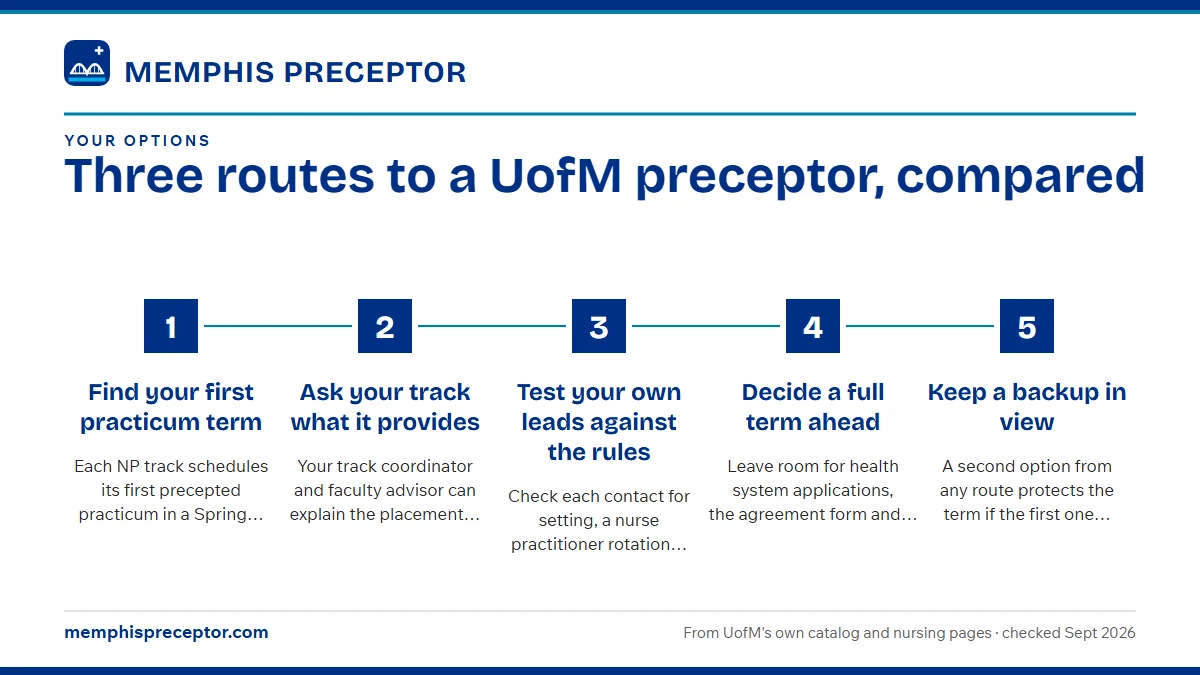
- Find your first practicum termEach NP track schedules its first precepted practicum in a Spring semester, while full-time Leadership students start immersion hours in their first term. Our first clinical course guide has the timing.
- Ask your track what it providesYour track coordinator and faculty advisor can explain the placement support and the timeline for your track.
- Test your own leads against the rulesCheck each contact for setting, a nurse practitioner rotation, the employer rule and the site's own student process.
- Decide a full term aheadLeave room for health system applications, the agreement form and your clearance items.
- Keep a backup in viewA second option from any route protects the term if the first one falls away. See our backup preceptors guide.
If you would like a placement advisor working with you from the start, share your track, town and term using the request form below or on our contact page.
Questions UofM students ask
Is it better to find my own preceptor or use a service?
It depends on your contacts, your timeline and how much of the paperwork you want to carry. A strong personal lead in the right setting is worth pursuing. A service makes the most sense when no fitting lead exists, your term is close, or you want someone checking UofM's rules and preparing the details with you. You can also combine the two.
What should I ask my track coordinator about placements?
Ask what placement support your track offers, how far ahead preceptor details are due, and whether a site you are considering already has an affiliation with the college. If the most convenient site is your employer, ask about that too, since UofM allows it only under compelling circumstances with faculty and administration approval.
Does a placement service replace UofM's approval?
No. Whoever found the preceptor, approval of the agreement form rests with the partnerships office, while your schedule and each clinical day rest with clinical faculty. A strong service prepares a complete file that already fits UofM's rules, which keeps the review moving. The decision always rests with the college.
Can I use different routes for different practicums?
Yes. Each practicum is its own placement, so a personal contact can cover one course and a placement service the next. Changing site within a course is a separate matter: a mid-course move requires sign-off in writing from both clinical faculty and the clinical coordinator, so plan any switch between courses where you can.
What if my own preceptor backs out before the term starts?
Start the replacement search at once and let your clinical faculty know, since a new preceptor means a new agreement form approved before your first clinical day. Our preceptor dropped out guide walks through the steps, and a placement advisor can take over the search the same day you reach out.
Related pages
Last checked 2026-09-27
We check these pages against UofM's 2026-27 catalog, the LCON Academic Bulletin, program pages and licensure disclosures. Your clinical faculty and your plan of study have the final word.
Whether UofM helps or you start alone, we find the preceptor.
Tell us your UofM concentration, your next practicum and the town you train near. We find preceptors and sites that fit the course and prepare what the preceptor agreement form needs, early enough for approval before the first clinical day.
- Preceptors matched to the rotation rules: an NP preceptor, family practice for FNP, inpatient and critical care for AG-ACNP
- License, certification and site details ready for the preceptor agreement form, with your Complio items in order
- Across the Mid-South, Tennessee and the states UofM serves
Start your placement plan
Your concentration, your town and your next clinical semester is all we need to begin.