Your RN license and UofM clinicals
UofM's graduate nursing programs ask for an RN license that is unrestricted and valid where your clinicals take place: Tennessee, or an approved state where your clinical assignments are completed. Tennessee's membership in the Nurse Licensure Compact lets one multistate license reach its compact neighbors, and whoever precepts you must be licensed for the state the rotation sits in.
Get your placement plan
Tell us your UofM program and where you live. A placement advisor replies with the preceptor and site options that fit your UofM course.
What UofM asks for, word for word
UofM states the license rule twice, once at admission and once at clinical clearance. The MSN admission requirement reads: "Eligibility to practice as a registered nurse in Tennessee or in an approved state in which clinical assignments are completed. Appropriate licensure/authorization must be obtained prior to the start of the program."
The clearance list in the LCON Academic Bulletin, which applies to MSN and graduate certificate students, is sharper: "An unrestricted license to practice as a registered nurse in Tennessee or license to practice in an approved state in which clinical assignments are to be completed." The 2026-27 graduate catalog adds that the unrestricted license has to stay in place for the whole program.
Read together, the two lines tie your license to the place where you precept rather than the place you applied from. A practicum across a state line needs a license that works in that state, and the state itself has to be one UofM treats as approved.
Your license has to fit the state of your clinical site, so a move or a site across a state line changes what you need.
Which states count as approved
The license rule leans on a second question: where the Loewenberg College of Nursing is authorized to run its online programs. UofM's own pages answer that in different ways, and California is the one state every source leaves out. The state authorization guide lays the sources side by side and shows how to get your state confirmed by LCON before you apply.
For planning, keep two layers apart. Your RN license is what lets you practice nursing in a state. LCON's authorization, and in some states a board review of programs based elsewhere, is what lets a UofM practicum run there. A clinical day in another state needs both layers in place.
Tennessee is the easy case. UofM Global says all of its programs meet Tennessee's licensing requirements, and the Tennessee Board of Nursing approves the college's programs, so a Tennessee RN training at a Tennessee site starts with both layers settled.
The Nurse Licensure Compact around Memphis
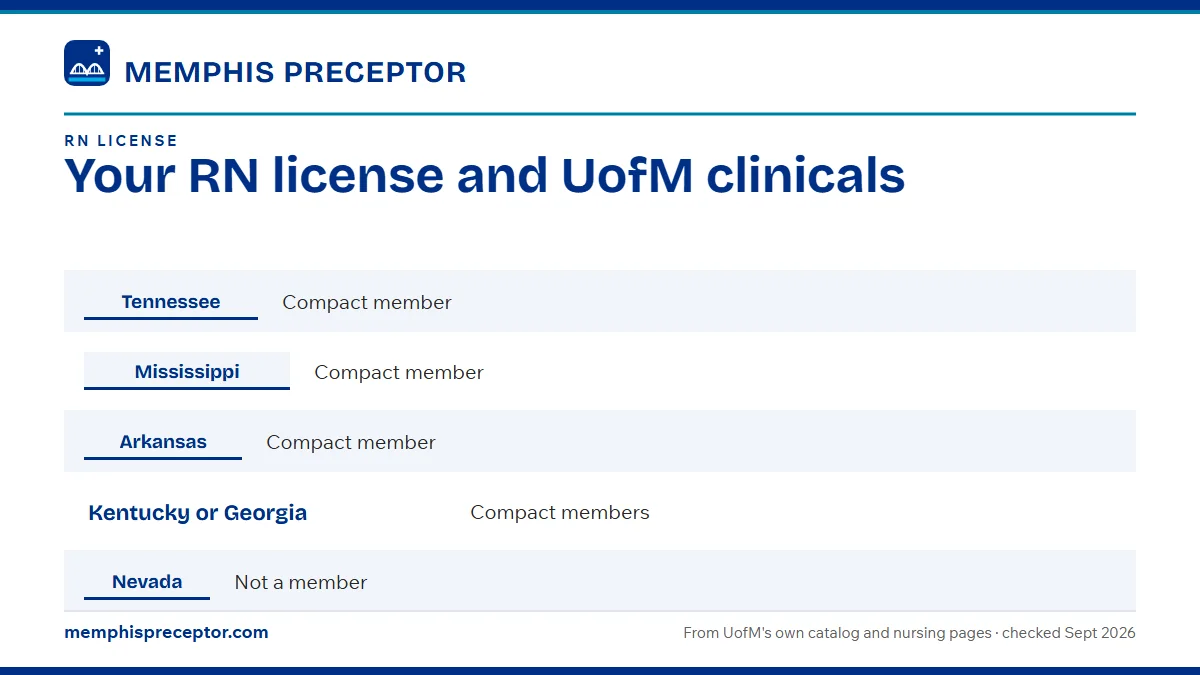
Tennessee is a compact state, and so are Mississippi and Arkansas, the two states that share the Memphis metro. The Mississippi Board of Nursing explains the practical effect: a nurse in good standing whose declared home is a compact state can work in the other member states without holding a separate license for each.
For a UofM student living in Southaven, Collierville or West Memphis, a multistate license from the compact state you call home is usually the cleanest route to clinicals on either side of the river. Mississippi's higher-education board wants graduate clinical students training there to be licensed for Mississippi without encumbrance, and a multistate privilege from another member state meets that. Program-level rules for Mississippi sites are on the Mississippi guide.
| Clinical site in | Compact status | License that fits UofM's rule |
|---|---|---|
| Tennessee | Compact member | A Tennessee license, or a multistate license from another compact state |
| Mississippi | Compact member | A multistate license from your compact home state, or a Mississippi license |
| Arkansas | Compact member | A multistate license from your compact home state, or an Arkansas license |
| Kentucky or Georgia | Compact members | The same pattern, with each board's own rules on top |
| Nevada | Not a member | A Nevada RN license |
| California | Not a member | A California RN license, though LCON is not authorized for distance education there |
Keeping the license unrestricted until you finish
An unrestricted license is a standing requirement, not a box ticked at admission. The graduate catalog lists losing an unencumbered RN license among the events that end a student's MSN, alongside a GPA below 3.0 and the five-year limit.
The LCON Academic Bulletin spells out the licensing grounds for academic disqualification:
- Probation by a Board of Nursing
- Failing to disclose a felony
- Failing to disclose Board of Nursing discipline or diversion
Renewal dates deserve the same care. The Bulletin's rule for clearance documents is that renewal dates must extend beyond the full placement period, so if your license renews in the middle of a practicum term, renew it before the term starts. Your other clearance items run on the same logic; the Complio guide covers them.
Your preceptor's license counts as much as yours
Tennessee's Board of Nursing sets the preceptor side in Rule 1000-01-.11. Your preceptor needs a clear license, at your target level of practice or higher, issued for the state where the precepting happens, plus proven competence in that clinical area. Schools keep watch on preceptor licenses through Nursys e-Notify, and faculty direct every student clinical experience, with the preceptor as an adjunct.
UofM layers its own rotation rules on top, including at least one rotation precepted by a nurse practitioner in each NP track; the rotation rules guide covers them. The preceptor's credentials also travel with the preceptor agreement form, which the Office of Community Partnerships and Practice approves before your first clinical day.
Across a state line the principle holds. A preceptor in Arkansas works on a license good in Arkansas, and a preceptor in Kentucky on one good in Kentucky, whatever state issued yours.
RN to BSN, RN to MSN and the pre-licensure tracks
The RN to BSN is built for working nurses, and the 2026-27 undergraduate catalog asks for an active, unencumbered RN license at entry, with a narrow opening for new graduates covered in the questions below. Its community health course, NURS 4126, includes direct and indirect patient care; the RN to BSN guide has the rest.
RN to MSN is an entry pathway into the MSN concentrations rather than a separate program. Applicants finish three undergraduate courses at LCON first, then the MSN admission rules apply in full, including the NCLEX-RN and the license rule above.
Students in the Traditional and Accelerated BSN are the exception to all of this. They are not yet licensed, and UofM assigns their clinical placements.
After graduation: the nurse practitioner license
The RN license carries you through UofM; the nurse practitioner license comes afterward, and each state issues its own. UofM's licensure disclosures for the MSN and graduate certificates close on that point: with board certification, graduates "may apply for an APRN license in each state where practice is desired."
In Tennessee, the APRN certificate rests directly on the RN license. The Board of Nursing looks for a Tennessee RN license or a multistate privilege, either one unencumbered, along with graduate nursing preparation at the master's level or above and current national certification. Prescribing adds a certificate of fitness and a collaborating physician, covered in Tennessee NP practice.
The practical upshot for a current student: the RN license you protect during the program is the base every later credential stands on.
How we check licenses before a match
With or without placement help from UofM, our job stays the same: a preceptor and a site that satisfy UofM's rules. The license check comes first, yours for the state of the site and the preceptor's for that same state at the level your track calls for.
- We confirm your license covers the state where the practicum will run, including multistate coverage across the Memphis metro.
- We match you with preceptors whose licenses are active and unencumbered where they practice.
- We gather the preceptor's license, board certification and practice information for the agreement well before the semester.
- We flag any renewal date that falls inside a practicum so nothing lapses mid-rotation.
Approval stays with UofM's clinical faculty and the Office of Community Partnerships and Practice. Our part is handing them a packet that is complete and rule-ready on the first pass. Send us your license state and track through the form below.
Questions UofM students ask
Do I need a Tennessee RN license to enroll in UofM's online MSN?
Not necessarily. UofM accepts an unrestricted Tennessee license or a license to practice in an approved state where your clinical assignments will be completed. If you train in a compact state, the multistate license from the member state you live in can cover it. Confirm that your state is one LCON is authorized in before you apply.
Can I use a Tennessee multistate license for clinicals in Mississippi or Arkansas?
Mississippi and Arkansas sit in the same compact as Tennessee, so a multistate license from your home state carries the right to practice in either. The state also has to be one where LCON may hold clinicals, and Mississippi reviews programs based elsewhere through its higher-education board, so settle the placement with LCON before committing to a site.
If a board restricts my RN license mid-program, what happens?
The graduate catalog treats losing an unencumbered RN license as grounds for leaving the MSN, and the Academic Bulletin adds Board of Nursing probation and undisclosed board discipline or diversion. Clinical practice depends on an unrestricted license, so speak with your Faculty Advisor and the MSN Program Director as soon as a board action begins.
Will a UofM NP program let me get licensed in another state?
UofM's licensure disclosures mark the FNP, AG-ACNP and PMHNP tracks as meeting requirements in the other 49 states and DC, with a note that California applicants must hold a California RN license. Graduates then apply for an APRN license in each state where they want to practice. Where you may train while enrolled is a separate question.
Can a new graduate start UofM's RN to BSN before holding an RN license?
Yes, provisionally. The 2026-27 undergraduate catalog lets applicants who are eligible for an RN license be accepted on a provisional basis, with proof of an active, unencumbered license due within six months. Plan your NCLEX date around that window, since the program is designed for licensed nurses.
Related pages
Last checked 2026-09-27
We check these pages against UofM's 2026-27 catalog, the LCON Academic Bulletin, program pages and licensure disclosures. Your clinical faculty and your plan of study have the final word.
Whether UofM helps or you start alone, we find the preceptor.
Tell us your UofM concentration, your next practicum and the town you train near. We find preceptors and sites that fit the course and prepare what the preceptor agreement form needs, early enough for approval before the first clinical day.
- Preceptors matched to the rotation rules: an NP preceptor, family practice for FNP, inpatient and critical care for AG-ACNP
- License, certification and site details ready for the preceptor agreement form, with your Complio items in order
- Across the Mid-South, Tennessee and the states UofM serves
Start your placement plan
Your concentration, your town and your next clinical semester is all we need to begin.