UofM's Adult-Gerontology Acute Care NP MSN and its hospital practicums
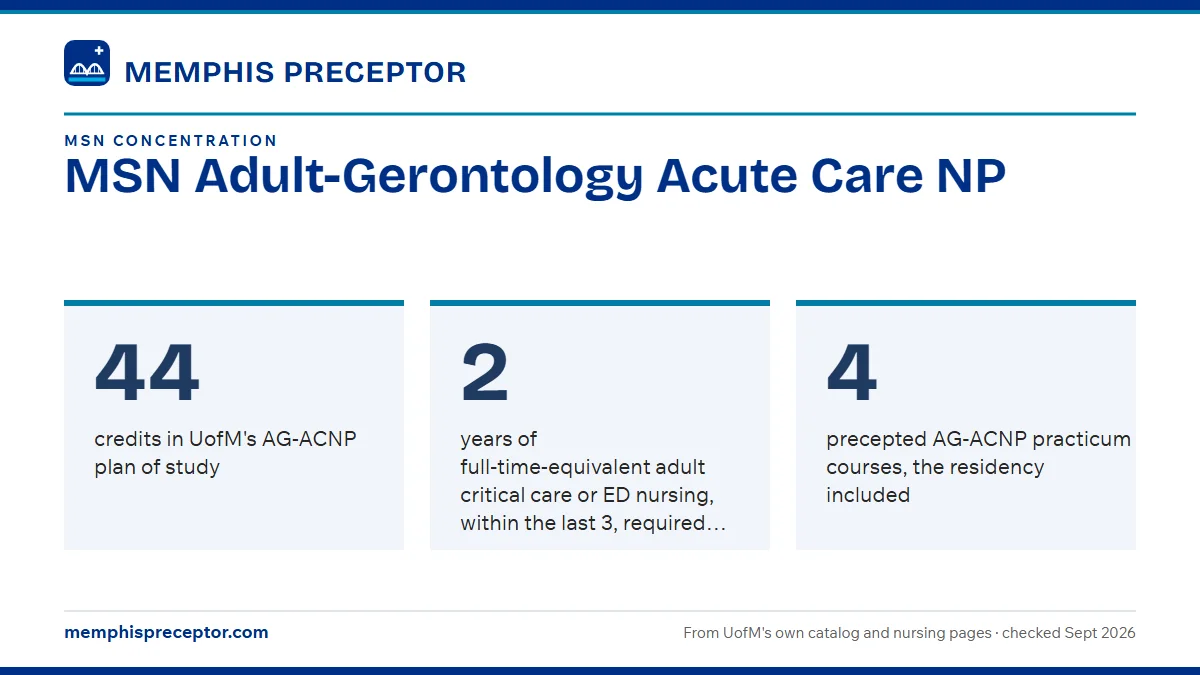
The AG-ACNP concentration at the University of Memphis is a 44-credit online MSN for nurses with recent adult critical care or emergency experience, followed by four precepted practicums in inpatient and critical care settings. Acute care preceptors work inside hospitals, where credentialing and affiliation steps take time, so the preceptor has to be arranged well ahead of the first spring practicum. Whether or not UofM has a hand in your placement, we find you an acute care preceptor and site that satisfy its rules.
Plan your AG-ACNP practicums
Share your start term, your town and the practicum coming up. A placement advisor replies with hospital-based preceptors and sites that fit.
Who the AG-ACNP track admits
This is the one UofM nurse practitioner track that sets a specific minimum of prior experience. The 2026-27 catalog wants the equivalent of at least two full-time years as an RN in adult critical care or an adult emergency department, all within the three years before you are admitted.
The MSN admissions page adds a practical detail: a hand-signed letter from a manager or director, not a charge nurse, naming the units where you worked. Once enrolled, you keep ACLS current for the whole program, on top of the AHA BLS every MSN student holds for clinical clearance.
Everything else matches the other MSN tracks: a 3.0 undergraduate GPA, the NCLEX-RN, undergraduate statistics, a current resume, and an RN license with no restrictions, valid in Tennessee or in the approved state where you will train. Fall entry closes July 1; spring entry closes December 1. California is excluded from LCON's distance programs, and the state authorization guide walks through the rest of the map.
The 44-credit plan of study
Coursework is online and follows the same three blocks as UofM's other NP tracks, with a larger specialty block for acute care.
| Block | Courses | Credits |
|---|---|---|
| MSN core | NURS 7021, 7022, 7023, 7024 | 12 |
| Advanced practice core | NURS 7101, 7102 (clinical lab), 7103, 7104 | 10 |
| AG-ACNP specialty | NURS 7621 through 7626, plus the NURS 7629 residency | 22 |
Part-time, the plan takes eight terms if you begin in fall or seven if you begin in spring, summers counted. Watch for a stray course list on UofM's site: it places the acute care courses under a Family Nurse Practitioner heading and labels the residency with the FNP number, NURS 7649. The catalog's NURS 7629 is the AG-ACNP residency.
The college also spells the track two ways, Adult Gerontology-Acute Care and Adult-Gerontology Acute Care. Both refer to the same concentration.
Four practicums and two hour totals
The catalog sets a minimum of 750 clock hours for AG-ACNP students. Where UofM's documents part ways is how those hours divide across the four courses.
| Course | Setting the catalog describes | Hours |
|---|---|---|
| NURS 7622 AG-ACNP I Practicum | A preceptor whose practice includes inpatient care; clinic, hospital or critical care | 180 (plan) or 170 (2026-27 Bulletin) |
| NURS 7624 AG-ACNP II Practicum | Acute and critical presentations of medical, surgical and traumatic illness | 180 or 170 |
| NURS 7626 AG-ACNP III Practicum | Hospitalist, intensivist or acute and critical presentations | 180 or 170 |
| NURS 7629 AG-ACNP Roles and Transition to Practice Residency | The final residency | 240 |
The part-time plan and the 2025-26 Bulletin give 180 hours for each of the first three practicums, 780 in all. The 2026-27 Bulletin's table gives 170 each, which lands exactly on 750. Until your clinical faculty confirm the figure for your cohort, planning around 180 per course keeps a lower total from catching you short.
The AG-ACNP practicums page walks through each course, and the NP hours guide compares all three NP tracks.
Inpatient preceptors and the hospitals behind them
The first AG-ACNP practicum asks for a preceptor who cares for hospitalized patients, and the later courses lean toward hospitalist and intensivist work. Much of your practicum time therefore lands inside hospitals rather than clinics, and hospitals run on their own timelines.
Take two Memphis systems. Baptist Memorial's graduate preceptorship form is due no less than three months ahead of the start date and lists every preceptor by name. Regional One Health hosts a preceptorship only once an affiliation agreement is signed. Each of those runs in parallel with UofM's own sign-offs: the preceptor agreement form cleared by the Office of Community Partnerships and Practice, then onboarding for the site in myClinicalExchange.
UofM also wants a nurse practitioner precepting one or more of your AG-ACNP rotations, and residency time in a specialty area is capped at 60 hours, subject to the Track Coordinator agreeing in advance. The rotation rules page lists the rest.
Your timeline: first practicum and campus visits
On both published plans NURS 7622 opens in spring: the fifth term for fall entrants, the fourth for spring entrants. That is about 17 or 12 months into the program, and hospital lead times move the preceptor work back into the summer or early fall before it. The second practicum, NURS 7624, sits in a summer term, so its preceptor belongs in the same planning round.
AG-ACNP students also carry the heaviest on-campus schedule. UofM's current intensive calendar makes more sessions mandatory for AG-ACNP than for the other tracks, and January 2027 brings a session that all NP students attend. Visits run one to three days, with at least six months' notice; the intensives guide has the rest.
Rules that apply in every AG-ACNP term
Admission requires recent critical care or emergency department work, so the employer rule is the one to read first.
- Logging hours where you are employed needs compelling circumstances, and then faculty and program administration have to approve the placement and put it on record (workplace clinicals).
- Every practicum carries a B-or-better floor and runs alongside its didactic partner course in one semester.
- By the second Monday of term, your clinical faculty member should have your schedule to approve; revisions go to them in writing seven days before they take effect.
- Hours for any one course have to be spread over seven weeks or more, and university breaks and holidays carry no clinical days unless faculty set something up.
- ACLS, BLS, immunizations and your Complio items stay current for the whole placement, since a clinical day missed because a document expired counts as unexcused.
Why AG-ACNP students choose us
Acute care placements reward an early start and a complete file, and that is how we work for every UofM student we take on.
- Hospitalist, intensivist and critical care preceptors matched to the setting each practicum describes.
- A nurse practitioner among your preceptors, so the NP rotation rule is covered early in the sequence.
- Hospital applications and their lead times tracked side by side with UofM's preceptor agreement form.
- Agreement-form details on each preceptor (license, board certification, practice information) collected early, with your myClinicalExchange onboarding started.
- A replacement search the day a preceptor or unit falls through.
Approval rests with UofM, through your clinical faculty and the partnerships office. We control the file, and we send it whole, accurate and matched to LCON's rules on the first try. Start with the form below or send us a message.
Questions UofM students ask
Does UofM's AG-ACNP accept emergency department experience?
Yes. Adult emergency department time counts the same as adult ICU time, provided the total reaches two full-time-equivalent years inside the three years before admission. The manager or director who signs your letter should name the units. Because the rule says adult, ask LCON admissions how they count mixed or pediatric experience before you apply.
Can AG-ACNP practicum hours be done in an outpatient clinic?
Partly. The first practicum's catalog description says the preceptor's practice must include inpatient care, while the student's time with that preceptor may be in a clinic, hospital or critical care setting. The later courses center on acute and critical presentations and hospitalist or intensivist work, so the sequence leans heavily toward hospital settings.
Do AG-ACNP students at UofM need ACLS?
Yes. The catalog requires AG-ACNP students to keep current ACLS throughout the program. That is in addition to the AHA BLS certification, immunizations, TB testing, annual background check and pre-term drug screen that every MSN student keeps current for clinical clearance. A certification that expires mid-placement can stop your clinical days.
Can I complete AG-ACNP hours in the ICU where I work?
Only in compelling circumstances, and even then the placement needs sign-off and documentation from faculty and program administration. Ask your clinical faculty whether a different unit in your own hospital still counts as your employer's site. A separate facility keeps the approval path simple and avoids the question entirely.
How early should an AG-ACNP preceptor be arranged?
Aim to have it settled by early fall for a spring practicum. Your preceptor agreement form must clear review before day one of clinicals, the site's myClinicalExchange onboarding has to be done, and some Memphis hospitals want applications three months out. The summer practicum that follows needs the same lead time.
Related pages
Last checked 2026-09-27
We check these pages against UofM's 2026-27 catalog, the LCON Academic Bulletin, program pages and licensure disclosures. Your clinical faculty and your plan of study have the final word.
Whether UofM helps or you start alone, we find the preceptor.
Tell us your UofM concentration, your next practicum and the town you train near. We find preceptors and sites that fit the course and prepare what the preceptor agreement form needs, early enough for approval before the first clinical day.
- Preceptors matched to the rotation rules: an NP preceptor, family practice for FNP, inpatient and critical care for AG-ACNP
- License, certification and site details ready for the preceptor agreement form, with your Complio items in order
- Across the Mid-South, Tennessee and the states UofM serves
Start your placement plan
Your concentration, your town and your next clinical semester is all we need to begin.