UofM preceptor and rotation rules for each NP track
The 2026-27 LCON Academic Bulletin keeps UofM's rotation rules short. Every NP track needs at least one rotation with a nurse practitioner as preceptor, FNP students need a family practice rotation and a family practice or internal medicine residency, and no NP student may spend more than 60 residency hours in a specialty area. Course descriptions in the graduate catalog then set the settings each practicum expects.
Match your rotations to UofM's rules
Tell us your track and which practicum comes next.
Two rules every NP track shares
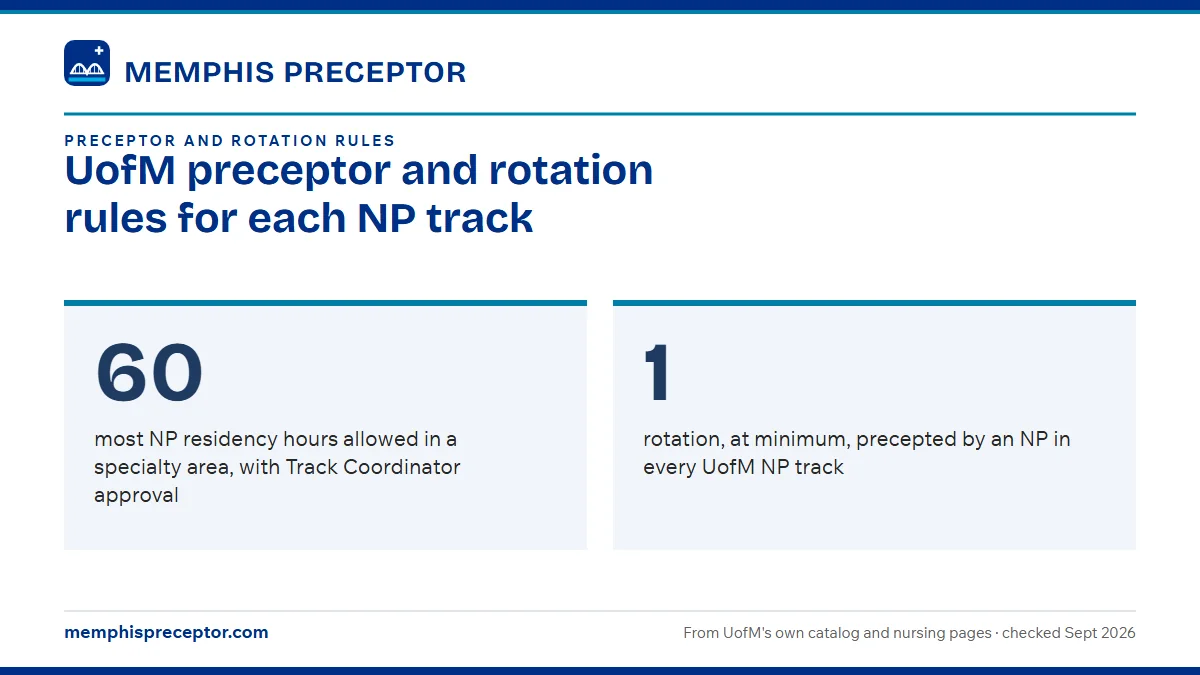
The Family NP, Adult-Gerontology Acute Care NP and Psychiatric-Mental Health NP tracks all carry the same line in the Bulletin: "At least one clinical rotation must be precepted by a nurse practitioner." UofM does not list which other clinicians may precept the remaining rotations, so clear any non-NP preceptor with your clinical faculty before the agreement form is drafted.
The second shared rule caps specialty time in the final residency: "Nurse practitioner students may spend a maximum of 60 hours during the final Residency semester in a specialty area of practice with prior approval of the respective Track Coordinator." The approval comes first, and the hours come after it.
NP students may return to a site they used earlier when the residency arrives. That flexibility helps when a strong preceptor from an earlier course has room for a longer stretch.
Family NP: family practice, twice over
FNP students carry two setting rules on top of the NP-preceptor rule. At least one rotation must be spent in a family practice setting, and the FNP Roles and Transition to Practice Residency, NURS 7649, must be completed in a family practice or internal medicine setting.
The catalog describes the first two practicums, NURS 7643 and NURS 7646, as care in a primary care setting, with the first covering acute problems in adults, older adults and children. One clean way to meet every FNP rule is a family practice NP preceptor for one of those two courses, followed by a family practice or internal medicine residency. Course details sit in the FNP practicums guide.
An AY 2020-21 FNP rule required FNP I, II and III to be completed in different clinical settings. That line is absent from the 2026-27 Bulletin. Hours are a separate question: UofM's plans disagree on the FNP total, so read the NP hour figures before counting on a number.
AG-ACNP: preceptors with inpatient practice
For the acute care track, the catalog sets the tone in NURS 7622: practice alongside a supervising preceptor whose practice includes inpatient care, in the clinic, hospital or critical care setting. The next two practicums build on it. NURS 7624 centers on acute and critical presentations of medical, surgical and traumatic illness, and NURS 7626 names hospitalist and intensivist practice.
The residency, NURS 7629, runs 240 hours, with the same 60-hour specialty ceiling as the other NP tracks. At least one of the four rotations needs an NP preceptor, so an acute care NP belongs somewhere in the sequence. The AG-ACNP practicums guide covers each course.
PMHNP: outpatient first, then inpatient
Psychiatric-mental health students begin with NURS 7612, an assessment and diagnosis practicum across the lifespan in the practice of a supervising preceptor. The catalog then splits the setting on purpose: NURS 7614 focuses on outpatient settings and NURS 7616 on inpatient settings, before the NURS 7619 residency.
UofM Global describes these practicums as supervised by qualified mental health preceptors in the student's own community. As with the other NP tracks, at least one rotation needs an NP preceptor, and a psychiatric NP in an outpatient clinic can cover that rule early. See the PMHNP practicums guide.
The rules side by side
| Track | Preceptor rule | Setting rule | Residency rule |
|---|---|---|---|
| FNP | At least one rotation with an NP preceptor | At least one family practice rotation; NURS 7643 and NURS 7646 in primary care | NURS 7649 in family practice or internal medicine; up to 60 specialty hours with approval |
| AG-ACNP | At least one rotation with an NP preceptor | Preceptor whose practice includes inpatient care; clinic, hospital or critical care | NURS 7629; up to 60 specialty hours with approval |
| PMHNP | At least one rotation with an NP preceptor | NURS 7614 outpatient, NURS 7616 inpatient | NURS 7619; up to 60 specialty hours with approval |
| Nursing Education | Qualifications not published | Immersions NURS 7207 and NURS 7209 | No return to a previous clinical site |
| Nursing Leadership | A qualified preceptor supervises NURS 7917 | Immersions NURS 7917 and NURS 7919 | Return allowed if preceptor qualifications are met |
Education and Leadership students have fewer written rules, but the residency one is firm: Nursing Education students will not return to a previous clinical site, so the second immersion needs a new setting.
What UofM leaves unwritten about preceptors
UofM publishes no preceptor qualification list. The Bulletin mentions preceptor qualifications without defining them, and no license type, minimum years in practice, certification or CV requirement appears. For Tennessee sites, the Board of Nursing fills part of the gap: the state asks for a preceptor whose unrestricted license comes from the state of the practicum and sits at the student's intended level or higher, working alongside clinical faculty rather than in their place. Tennessee NP practice and preceptors explains the state side.
Two further points come straight from UofM. Faculty and preceptors rate you on the Student Clinical Evaluation Tool, and both the clinical faculty and the preceptor must judge you competent before you can complete the course. Hours at a site that employs you need faculty and program administration approval first; see workplace clinicals.
The spring 2025 Bulletin capped specialty time at 20% of a semester's clinical time with clinical coordinator approval. The current rule is 60 residency hours with Track Coordinator approval, so plan to that one.
How we match preceptors to these rules
However UofM handles your placement, our matching begins with these rotation rules. For each course we check the preceptor's role and setting against your track: an NP where your plan still needs one, a family practice site for FNP, a preceptor with inpatient practice for AG-ACNP, and the right outpatient or inpatient psychiatric setting for PMHNP.
We map the whole plan of study at once, so the NP-precepted rotation and the FNP family practice rotation are covered early instead of being left to the residency term. If specialty hours suit your goals, we keep them inside the 60-hour ceiling and flag the Track Coordinator approval well ahead. Faculty make the final call, and the match they review already fits UofM's rules. Tell us your track in the form below.
Questions UofM students ask
Can part of my NP residency be in a specialty clinic?
Yes, within a limit. UofM lets NP students spend up to 60 hours of the final residency semester in a specialty area of practice, provided the Track Coordinator approves it beforehand. For FNP students, the rest of the residency still has to take place in family practice or internal medicine.
Can a physician or PA precept me at UofM?
UofM's written rule only requires that at least one rotation in each NP track be precepted by a nurse practitioner. It does not publish a list of other eligible preceptor types, so confirm any physician or physician assistant preceptor with your clinical faculty before the preceptor agreement form is prepared.
Can I go back to an earlier clinical site for my residency?
NP students may return to a previous site. Nursing Leadership students may as well, provided the preceptor qualifications are met. Nursing Education students will not return to a previous clinical site for the residency, so they need a fresh setting for NURS 7209.
Do my FNP practicums have to be at different clinics?
An AY 2020-21 rule required FNP I, FNP II and FNP III in different clinical settings, but that line does not appear in the 2026-27 Bulletin, which keeps the family practice and NP-preceptor rules instead. Ask your clinical faculty whether your course expects a change of setting.
Does my AG-ACNP preceptor need to work in an ICU?
Not for every course. The catalog asks for a preceptor whose practice includes inpatient care and allows clinic, hospital or critical care settings in NURS 7622. Later practicums lean toward acute and critical presentations and hospitalist or intensivist practice, so the setting moves further into hospital and critical care as the track goes on.
Related pages
Last checked 2026-09-27
We check these pages against UofM's 2026-27 catalog, the LCON Academic Bulletin, program pages and licensure disclosures. Your clinical faculty and your plan of study have the final word.
Whether UofM helps or you start alone, we find the preceptor.
Tell us your UofM concentration, your next practicum and the town you train near. We find preceptors and sites that fit the course and prepare what the preceptor agreement form needs, early enough for approval before the first clinical day.
- Preceptors matched to the rotation rules: an NP preceptor, family practice for FNP, inpatient and critical care for AG-ACNP
- License, certification and site details ready for the preceptor agreement form, with your Complio items in order
- Across the Mid-South, Tennessee and the states UofM serves
Start your placement plan
Your concentration, your town and your next clinical semester is all we need to begin.