UofM's FNP practicums, course by course
The Family Nurse Practitioner concentration at UofM runs three precepted courses in a fixed order: NURS 7643 for acute problems, NURS 7646 for chronic problems, then the NURS 7649 residency. The current plan of study gives each one 250 clock hours, all of them in primary care close to home. Whether or not UofM takes a hand in your placement, we find FNP preceptors who fit each course and have their details ready well before the term.
Plan your FNP practicums
Tell us your start term and where you live, and your placement advisor maps a preceptor to each course.
The three FNP practicum courses at a glance
Each FNP practicum sits beside didactic companions at the same level. NURS 7643 runs with NURS 7641 (acute manifestations and differential diagnosis) and NURS 7642 (acute problems management). NURS 7646 runs with NURS 7644 and NURS 7645, the chronic-problems pair. The residency stands alone as the final clinical term.
| Course | Title | Credits | Clock hours | Setting UofM names |
|---|---|---|---|---|
| NURS 7643 | FNP I Acute Problems Practicum | 3 | 250 | Primary care, all ages |
| NURS 7646 | FNP II Chronic Problems Practicum | 3 | 250 (2024 plan: 240) | Primary care |
| NURS 7649 | FNP Roles and Transition to Practice Residency | 4 | 250 (2024 plan: 240) | Family practice or internal medicine |
LCON treats a practicum and its companions as one unit. You take them in the same semester, and if you repeat one, you repeat its partner too. Every FNP practicum needs a B or better before you move on; the grades and progression guide covers repeats and the five-year limit.
NURS 7643: acute problems, first in line
The catalog describes FNP I as "acute advanced nursing care to adults, older adults, and children in a primary care setting." That last clause shapes the search. A preceptor with an adults-only panel covers part of the course, so the strongest fit is a family practice that sees toddlers and grandparents in the same week.
The part-time plan of study places NURS 7643 in spring. Fall starters reach it in term five and spring starters in term four. The NURS 7102 health assessment clinical comes one term earlier. FNP certificate students, admitted in spring only, meet NURS 7643 in their first term. The first clinical course guide lays out the same timing for every UofM program.
A family practice preceptor also does double duty here. UofM wants at least one FNP rotation in family practice and at least one with a nurse practitioner as preceptor, so an NP in family practice for FNP I settles both requirements early and leaves you room to choose later.
NURS 7646: chronic problems in primary care
FNP II keeps you in primary care but moves the weight to chronic conditions: follow-up visits, medication adjustments, patients who return every few months. The 2025 plan of study sets it at 250 hours, while the 2024 FNP plan, still linked from LCON's program index, shows 240. The plan places FNP II in a summer term.
Summer changes the arithmetic. UofM's rule that a course's clinical hours take at least seven weeks still holds, and university holidays stay off the clinical calendar unless faculty arrange otherwise. A preceptor who can give you steady days through a shorter term matters more here than anywhere else in the sequence. See what counts as clinical hours for the full list of limits.
Can FNP I and FNP II share a site? The 2020-21 MSN handbook said FNP I, II and III had to be in different clinical settings. The current bulletin does not carry that line, so ask your clinical faculty before you plan two courses with one preceptor. We plan for either answer.
NURS 7649: the residency in brief
The residency is the last FNP practicum and has its own guide: the NP residency. In short, it must take place in a family practice or internal medicine setting, every core and specialty course must be finished before it starts, and no course may be repeated during it.
You may go back to a site you used earlier, and up to 60 residency hours can go to a specialty area if the Track Coordinator approves them in advance. The Programmatic Cumulative Evaluation also sits in this course. Because the residency is the one FNP course whose setting UofM fixes by name, we confirm the residency preceptor's practice type before anything else. A preceptor you already know from FNP I or FNP II can be a strong choice when the practice qualifies.
750, 730 or 720: which FNP total is right
UofM's sources disagree on FNP hours. The 2026-27 catalog sets a 750-hour minimum, and both the 2025 plan of study and the LCON Academic Bulletin reach 750 with three 250-hour courses. The 2024 FNP plan, still posted, lists 250, 240 and 240 for a total of 730. One FNP certificate plan shows 240 in each course, which comes to 720.
Plan for at least 750 and treat the smaller figures as older paperwork. The catalog and the bulletin decide, and your clinical faculty can confirm the count for your cohort. If a preceptor can offer only enough days for 240 hours, that gap surfaces at the end of the term, the worst possible moment to find it. The NP clinical hours guide compares the figures across all three NP tracks.
How we line up the whole FNP sequence
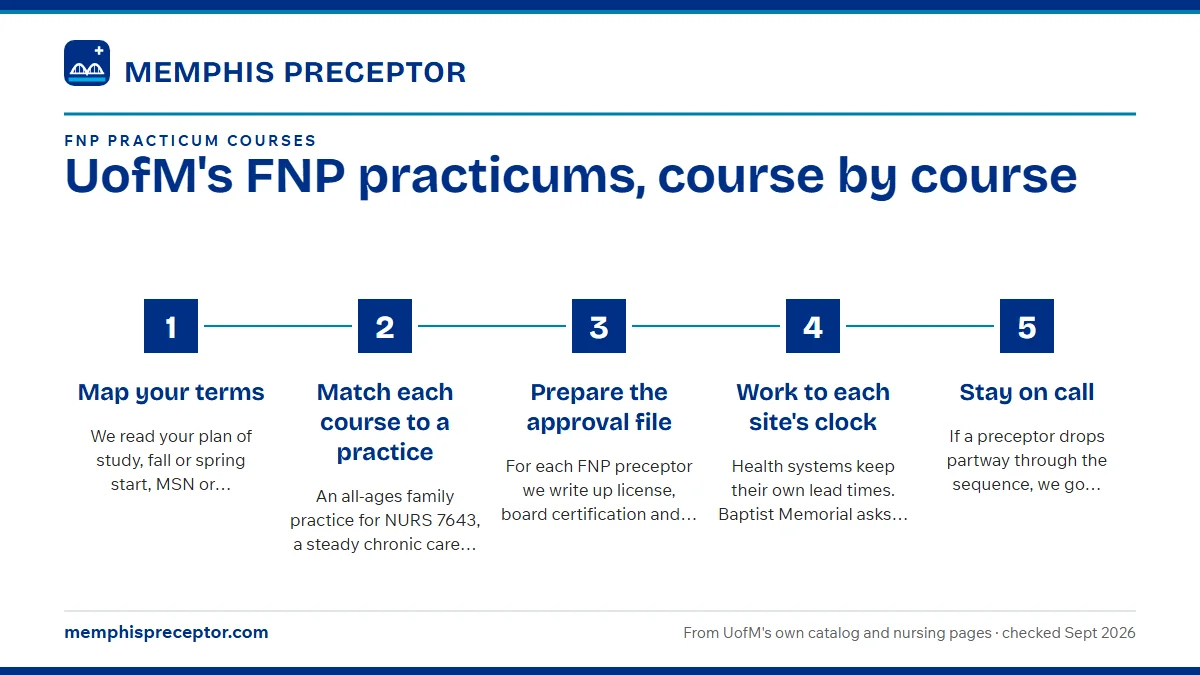
- Map your termsWe read your plan of study, fall or spring start, MSN or certificate, and mark the term each practicum falls in, so the search for FNP I begins long before that spring.
- Match each course to a practiceAn all-ages family practice for NURS 7643, a steady chronic care panel for NURS 7646, and a family practice or internal medicine preceptor for NURS 7649, with a nurse practitioner precepting at least one of them.
- Prepare the approval fileFor each FNP preceptor we write up license, board certification and practice type in the shape the preceptor agreement form expects, add the site's information, and check your Complio and myClinicalExchange items against the start date.
- Work to each site's clockHealth systems keep their own lead times. Baptist Memorial asks graduate nursing students to apply at least three months before the start date and to name every preceptor, and Christ Community Health Services takes NP rotation applications by July 15 for rotations starting between January 2 and April 30.
- Stay on callIf a preceptor drops partway through the sequence, we go straight to another primary care option for that course and help you request the site change in writing.
Clinical faculty at UofM approve every preceptor and schedule. Our part is a file that answers their FNP questions before they ask, delivered early. Tell us your start term and we begin with the course that comes first.
Questions UofM students ask
Does FNP I at UofM require pediatric patients?
The catalog description for NURS 7643 names children alongside adults and older adults in a primary care setting. UofM does not publish a separate pediatric hour count for the FNP track, so the practical answer is a preceptor whose panel spans all ages, such as a family practice. Your clinical faculty confirm what your section expects before the term starts.
Is the NURS 7102 health assessment clinical precepted?
NURS 7102 is a one-credit clinical course in UofM's Advanced Nursing Practice core, and it needs a B or better to progress. The 2024 FNP plan describes it as a 30-hour lab. UofM's public pages do not say whether it uses an outside preceptor, so check the course's Canvas site or ask the course faculty before that term.
Do FNP certificate students take the same practicums?
Yes. The FNP graduate certificate uses NURS 7643, NURS 7646 and NURS 7649. Its plan shows spring admission only, with FNP I in the first term, so certificate students need a preceptor in place soon after they are admitted. One certificate plan lists 240 hours per course, so confirm the total with your clinical faculty.
What happens if I do not pass an FNP practicum?
The practicum and its companion didactic courses are repeated together at the next offering, and the repeat must earn a B or better. A grade below B on a repeated course is grounds for disqualification, and graduate students may repeat no more than two courses across their whole graduate career. A well-matched preceptor from the first day is worth the effort.
How many hours a week does a 250-hour practicum take?
It depends on how many weeks your preceptor can give you. UofM does not let a course's hours be finished in under seven weeks, and 250 hours across seven weeks is about 36 hours a week. Spread across a full 14-week semester, it is closer to 18. We look for preceptors whose schedules fit the pace your term allows.
Related pages
Last checked 2026-09-27
We check these pages against UofM's 2026-27 catalog, the LCON Academic Bulletin, program pages and licensure disclosures. Your clinical faculty and your plan of study have the final word.
Whether UofM helps or you start alone, we find the preceptor.
Tell us your UofM concentration, your next practicum and the town you train near. We find preceptors and sites that fit the course and prepare what the preceptor agreement form needs, early enough for approval before the first clinical day.
- Preceptors matched to the rotation rules: an NP preceptor, family practice for FNP, inpatient and critical care for AG-ACNP
- License, certification and site details ready for the preceptor agreement form, with your Complio items in order
- Across the Mid-South, Tennessee and the states UofM serves
Start your placement plan
Your concentration, your town and your next clinical semester is all we need to begin.