UofM's nurse practitioner certificates, and how soon their practicums begin
For nurses who have already completed graduate nursing study, the Loewenberg College of Nursing offers graduate certificates in FNP, AG-ACNP and PMHNP. They use the MSN's practicum courses and hour rules, but on UofM's published plans the first practicum arrives in the very first term. Wherever your placement support comes from, we have a preceptor and site that fit UofM's rules ready before that term opens.
Plan your certificate practicums
Tell us which NP certificate, your intended start term and where you live. A placement advisor replies with preceptors and sites that fit.
Who the NP certificates are for
These are post-graduate programs. CCNE accredits them as post-graduate APRN certificates, and the Tennessee Board of Nursing lists UofM's post-master certificates with full approval alongside the MSN tracks.
Entry assumes the advanced practice core is behind you: NURS 7101 through NURS 7104 or their equivalents (assessment, its clinical lab, pathophysiology and pharmacology), each with a B or better, finished within the past five years or backed by recent APRN practice. If your core is older or missing, UofM adds it to your plan, and each certificate's credit total rises by ten.
That makes the certificates a fit for APRNs adding a second population focus and for nurses who finished graduate study and now want a nurse practitioner role. An unrestricted RN license is still required, valid in Tennessee or the approved state where you complete clinicals, along with the Complio and myClinicalExchange clearance MSN students carry.
Credits, length and start term by certificate
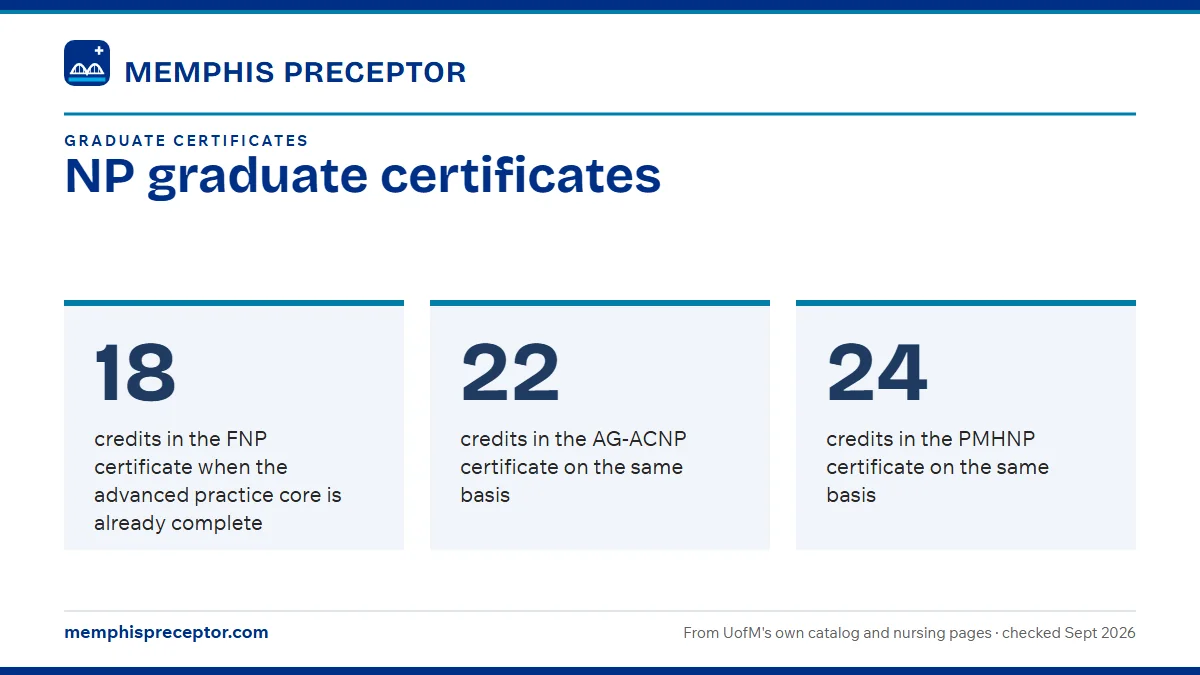
The three certificates differ in size and in how much UofM has published about them.
| Certificate | Credits | Published plan | Start on the plan | Clinical hours |
|---|---|---|---|---|
| FNP | 18 (18 to 28 with the core) | 3 terms | Spring | 750, or 720 on a second plan |
| AG-ACNP | 22 (22 to 32 with the core) | No plan of study found | Not published | 780 or 750 |
| PMHNP | 24 (24 to 34 with the core) | 4 terms | Spring | 750 |
Each base credit total lines up with the specialty block of the matching MSN concentration: the FNP courses numbered in the 7640s, the AG-ACNP courses in the 7620s and the PMHNP courses in the 7610s. In effect, a certificate is the MSN's population courses and practicums without the four-course MSN core, which is why the clinical load stays the same while the credit count shrinks.
Start terms are a conflict worth settling early. The certificate page lists fall and spring application windows, while the FNP and PMHNP plans of study show a spring start only. Application deadlines are July 1 for fall and December 1 for spring. Ask the track coordinator which term your certificate actually admits before you plan around it.
The MSN's practicums, taken as a certificate
Certificate students enroll in the same practicum courses as MSN students and follow identical rotation rules: an NP must precept one rotation or more, FNP students need family practice time and a residency in family practice or internal medicine, AG-ACNP preceptors must bring inpatient practice, and PMHNP students cover outpatient and inpatient psychiatric settings.
Course detail lives on the practicum guides: FNP practicums, AG-ACNP practicums and PMHNP practicums.
Hours carry the same disagreements as the MSN. For FNP, one certificate plan (reached from the college's program index) shows 250 hours a course, and another (reached from the certificate page) shows 240, a total of 720 against the catalog's 750-hour minimum. For AG-ACNP, the 2025-26 Bulletin totals 780 and the 2026-27 Bulletin 750. The NP hours guide lays the figures out; your clinical faculty confirm the one that applies to you.
Your first practicum can come in your first term
This is the biggest difference from the MSN. On the FNP certificate plan, NURS 7643 sits in term one, a spring term. On the PMHNP certificate plan, NURS 7612 does the same. An MSN student reaches the first practicum about a year or more into the program; a certificate student can meet it within weeks of the first class.
Before that first clinical day, UofM's Office of Community Partnerships and Practice has to approve your preceptor agreement form, and myClinicalExchange onboarding for the site must be done. For a January start, preceptor planning overlaps the application itself, since the spring deadline is December 1.
No AG-ACNP certificate plan was found, so ask the track coordinator when NURS 7622 falls for you. The first clinical course guide compares every UofM program's timing.
Rules that read a little differently for certificates
Most clinical rules match the MSN word for word. A few catalog details differ, and one page is out of date.
- Grade wording: the FNP certificate's catalog page asks for a B in all clinical and lab courses, while the AG-ACNP and PMHNP certificate pages say all courses. Practicum courses require a B or better under every version.
- Re-entry: after an academic disqualification, a certificate student may reapply after one year, compared with three years for the MSN.
- Campus visits: certificate students in the NP tracks come to campus for as many as three short intensives. The certificate page still shows an older schedule, so use the current list on the MSN page and the intensives guide.
- Licensure: UofM publishes a separate licensure disclosure for its graduate certificates, and it conflicts with the college's state list in the same way the MSN's does (state authorization).
Why certificate students choose us
A first-term practicum leaves no slack, and that is where a thorough, early search pays off most. We start while your application is still in review.
- Preceptors matched to your population focus: family practice, inpatient acute care, or outpatient and inpatient psychiatry.
- A nurse practitioner preceptor in the plan from the start, so the NP rotation rule is covered well before the residency.
- The preceptor's license, certification and practice details assembled for the agreement form well before January.
- Your Complio and myClinicalExchange items checked against each site's onboarding list.
- A replacement ready to go if a preceptor or site withdraws.
Every preceptor and site gets UofM's sign-off, and the file we put in front of its reviewers leaves nothing for them to chase. Tell us your certificate and start term in the form below.
Questions UofM students ask
Who is eligible for UofM's post-master's NP certificates?
Nurses who have completed graduate nursing coursework that includes advanced health assessment with its clinical lab, pathophysiology and pharmacology, with a B or better, within five years or alongside recent APRN practice. You also need an unrestricted RN license in Tennessee or an approved state. Without that core, UofM adds ten credits to the certificate.
Can I start a UofM NP certificate in the fall?
UofM's sources disagree. The graduate certificate page publishes fall and spring application windows, but the FNP and PMHNP certificate plans of study show a spring start only, and no AG-ACNP certificate plan is posted. Ask the track coordinator for your certificate before you apply, and plan your first practicum around the answer.
Do certificate students complete all 750 clinical hours?
Yes. The certificates use the MSN's practicum courses, so the hour load matches the MSN for each population. Across the NP tracks, UofM's catalog puts the minimum at 750 clock hours, though one FNP certificate plan shows 720 and the AG-ACNP figure appears as 780 in the plan of study and the 2025-26 Bulletin. Ask your track coordinator before counting on earlier clinical hours from another program.
Is UofM's post-graduate APRN certificate accredited?
Yes. CCNE's directory lists UofM's post-graduate APRN certificate programs as accredited, with the current term running to June 30, 2030, and the Tennessee Board of Nursing's school list shows the MSN tracks and post-master certificates with full approval. The accreditation guide covers UofM's institutional accreditation as well.
Can certificate clinicals take place outside Tennessee?
They can happen in the state where you hold your RN license, provided UofM treats that state as approved. California is outside LCON's distance education authorization, and the college's list of 16 authorized states disagrees with the licensure disclosure, which answers a separate question about APRN licensing. Confirm your state with LCON before you apply.
How long does the UofM FNP certificate take?
The published plan is three terms, starting in spring, for a student whose advanced practice core is already complete. All three FNP practicums fall inside those terms, so each term carries a precepted course. Students who still need the advanced practice core add those ten credits, which lengthens the plan; the track coordinator maps the order.
Related pages
Last checked 2026-09-27
We check these pages against UofM's 2026-27 catalog, the LCON Academic Bulletin, program pages and licensure disclosures. Your clinical faculty and your plan of study have the final word.
- Loewenberg College of Nursing: graduate certificates
- UofM 2026-27 graduate catalog: Graduate Certificate, Family Nurse Practitioner
- UofM 2026-27 graduate catalog: Graduate Certificate, Psychiatric-Mental Health Nurse Practitioner
- LCON Academic Bulletin AY 2026-27
- UofM Global: professional licensure disclosure, graduate nursing certificates
Whether UofM helps or you start alone, we find the preceptor.
Tell us your UofM concentration, your next practicum and the town you train near. We find preceptors and sites that fit the course and prepare what the preceptor agreement form needs, early enough for approval before the first clinical day.
- Preceptors matched to the rotation rules: an NP preceptor, family practice for FNP, inpatient and critical care for AG-ACNP
- License, certification and site details ready for the preceptor agreement form, with your Complio items in order
- Across the Mid-South, Tennessee and the states UofM serves
Start your placement plan
Your concentration, your town and your next clinical semester is all we need to begin.