From your first message to approved clinical hours
Whatever role UofM plays in arranging your practicum, the job we take on stays the same: a preceptor and site that fit your Loewenberg College of Nursing course, close to where you live, with every detail ready before the Office of Community Partnerships and Practice looks at it. The five stages below run in sequence, from intake to the last logged hour.
Get your placement plan
Tell us your UofM program and where you live. A placement advisor replies with the preceptor and site options that fit your UofM course.
Step 1: Your track, your town and your term
A short intake opens the process. You tell us your UofM concentration or certificate, the practicum course coming up, the town you live in, the longest commute you will accept and the term the hours fall in. The course number shapes the search: a Family Nurse Practitioner student heading into NURS 7643 needs different clinicians from a Psychiatric-Mental Health NP student preparing for the inpatient focus of NURS 7616.
We also ask where you work. UofM keeps practicum hours away from a student's current employer unless compelling circumstances prevail, and in that case faculty and program administration sign off on the placement and document it. Naming your employer at intake keeps it off the search list from day one.
Already have a lead, such as a clinician you have worked alongside or a practice that hosts students? Share it. Your placement advisor tests it against the same rules as every other candidate.
Step 2: A search shaped by UofM's rotation rules
Your placement advisor looks for clinicians near your home whose practice matches what the course demands. UofM's Academic Bulletin sets requirements by track, and the search follows them from the first call rather than discovering them at approval time.
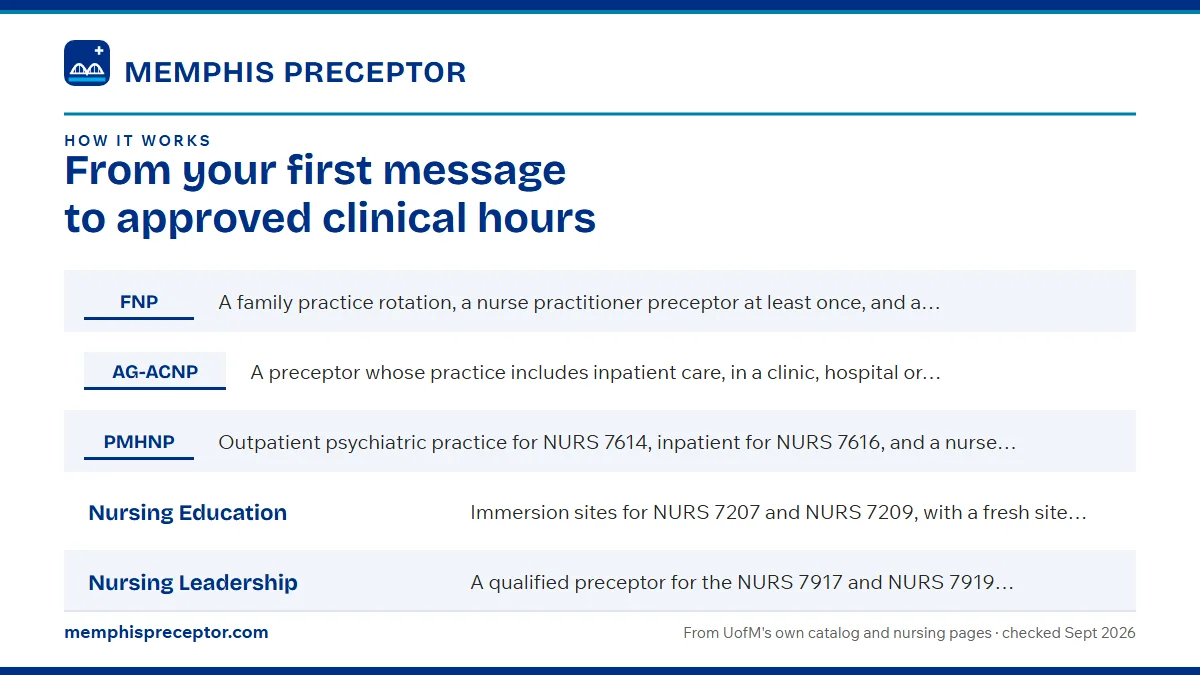
| Track | What the match has to include |
|---|---|
| FNP | A family practice rotation, a nurse practitioner preceptor at least once, and a residency (NURS 7649) in family practice or internal medicine |
| AG-ACNP | A preceptor whose practice includes inpatient care, in a clinic, hospital or critical care setting, plus a nurse practitioner preceptor at least once |
| PMHNP | Outpatient psychiatric practice for NURS 7614, inpatient for NURS 7616, and a nurse practitioner preceptor at least once |
| Nursing Education | Immersion sites for NURS 7207 and NURS 7209, with a fresh site for the residency |
| Nursing Leadership | A qualified preceptor for the NURS 7917 and NURS 7919 immersions |
The complete set, including the 60-hour cap on specialty time during an NP residency, sits in our rotation rules guide.
Step 3: The preceptor says yes before you hear the name
A name on a list is only a starting point. Before a preceptor reaches you, we confirm the clinician is happy to host a UofM student during your semester, that the hours can spread across at least seven weeks, and that the setting fits your course. We also learn how the site itself handles students, because health systems run very different processes.
Some of those differences are large. Baptist Memorial wants its graduate preceptorship application in hand a full three months ahead of the proposed affiliation date, with each preceptor listed by name. Regional One Health wants an affiliation agreement signed and executed before any clinical rotation begins. Your timeline gets planned around whichever process your site uses, so a slow step is spotted early instead of in the final week.
Step 4: The agreement file, ready for review
Under UofM's Bulletin, no clinical day can start until the partnerships office, formally the Office of Community Partnerships and Practice, has reviewed and signed off on a completed preceptor agreement form. We gather what goes into it from the preceptor, meaning license, national certification and practice details, along with the site's name, address and setting. Our agreement form guide explains the approval step itself.
While that file comes together, we walk through your own clearance with you. UofM tracks compliance in DISA Complio and onboards students to clinical sites through HealthStream myClinicalExchange, and a site holds off on clearing you until each required document shows as accepted. Documents must stay valid for the full placement, so we flag anything due to lapse mid-term, including the drug screen, which has to fall inside the 30-day window ahead of each fall or spring clinical term. The Complio guide lists every item.
Approval itself belongs to UofM's faculty and the partnerships office. We hand you a file built to clear that review cleanly, with nothing missing and nothing out of line with your track.
Step 5: Schedule, hours and a backup on call
Approval opens the next UofM deadline quickly. Clinical faculty expect your schedule on the Monday of week two, and changes after that need written notice seven days before they take effect. We help you build a schedule your preceptor can actually keep, spread over at least seven weeks and with no clinical days on university breaks or holidays unless faculty set that up.
Support continues until your final hour is logged. Should your preceptor leave partway through, a replacement search begins at once and a new file is prepared, because moving to a new site takes approval, in writing, from both your clinical faculty and the clinical coordinator. The preceptor dropped out guide covers that situation step by step.
When to begin
Earlier is better, and UofM's plans of study show why. Across the three NP tracks, the opening precepted practicum sits in a Spring semester, about a year into the plan for Spring starters and about 17 months in for Fall starters. A Spring practicum means lining up your preceptor during the Fall before it.
Nursing Leadership is the track to watch. Full-time Leadership students begin immersion hours in their very first term, so their search should begin as soon as admission is settled. Our first clinical course guide sets out the timing for each program.
Ready to begin? Use the form at the bottom of this page or our contact page to share your track and town, and your placement advisor will map out what comes first.
Questions UofM students ask
Can I bring a preceptor I already know?
Yes. Give your placement advisor the clinician's name and practice, and the lead gets the same review as any other candidate: setting, track rules, schedule and the site's own student process. If it fits, we prepare the agreement details for it. If something falls short, you hear exactly what and why, and alternatives are already being lined up.
Who approves the preceptor you find?
UofM does. The college's partnerships office signs off on the preceptor agreement form ahead of your first day in clinic, and your clinical faculty approve your schedule and every clinical day after that. Our role is the search and the preparation, so the file UofM receives is complete and already matches its rules.
Do you help UofM students who live outside Tennessee?
Yes. UofM's MSN clinicals take place where you live, so your RN license has to come from Tennessee or from an approved state where the clinicals happen. California is off the table, since UofM lacks authorization for distance education there, and UofM's own state lists disagree elsewhere, so check your state with the college before committing. Our state authorization guide explains the conflict.
What should I have ready before the search starts?
Your concentration and plan of study, the practicum course and term, your home area and driving range, and the name of your employer. It also pays to open your Complio account early, because clearance items such as the annual background check and immunizations take time, and a site will not approve you until each one is accepted.
Can you plan more than one practicum in my program?
Yes. Many plans are easier to handle as a sequence, from the first practicum through the residency. Mapping the sequence early means your advisor can target a practice able to host more than one course where UofM allows a return, and secure the family practice or internal medicine residency setting FNP students need well before that term.
Related pages
Last checked 2026-09-27
We check these pages against UofM's 2026-27 catalog, the LCON Academic Bulletin, program pages and licensure disclosures. Your clinical faculty and your plan of study have the final word.
Whether UofM helps or you start alone, we find the preceptor.
Tell us your UofM concentration, your next practicum and the town you train near. We find preceptors and sites that fit the course and prepare what the preceptor agreement form needs, early enough for approval before the first clinical day.
- Preceptors matched to the rotation rules: an NP preceptor, family practice for FNP, inpatient and critical care for AG-ACNP
- License, certification and site details ready for the preceptor agreement form, with your Complio items in order
- Across the Mid-South, Tennessee and the states UofM serves
Start your placement plan
Your concentration, your town and your next clinical semester is all we need to begin.