Clinical hours in every UofM nursing program
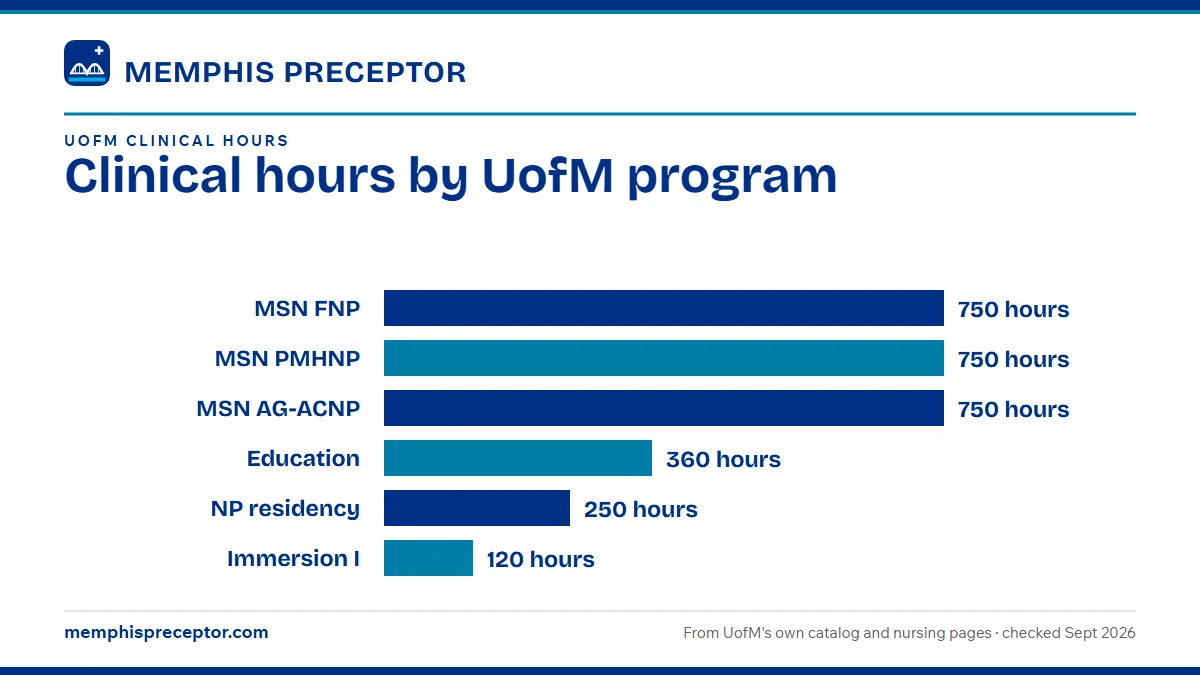
Every UofM nurse practitioner track is built on at least 750 clock hours spread over three or four precepted courses, and the MSN in Nursing Education or Nursing Leadership asks for 360 immersion hours. The planner below breaks each graduate program into its courses. The sections after it explain how those totals are put together, where UofM's own documents disagree, and how we line up a preceptor for every hour.
Get your placement plan
Tell us your UofM program and where you live. A placement advisor replies with the preceptor and site options that fit your UofM course.
Pick your UofM program
Your clinical courses and hours, who can precept you, where, and when to start looking. From UofM's own catalog and nursing pages.
- Who precepts
- At least one nurse practitioner preceptor, with a family practice rotation
- Where
- Primary care in your local area; the residency in family practice or internal medicine
- Start looking
- The first practicum falls in a spring term
- Who precepts
- Acute care preceptors whose practice includes inpatient care, at least one of them an NP
- Where
- Hospital, hospitalist, intensivist and critical care settings
- Start looking
- The first practicum falls in a spring term
- Who precepts
- Psychiatric mental health preceptors across the lifespan, at least one of them an NP
- Where
- Outpatient settings first, then inpatient psychiatric care
- Start looking
- The first practicum falls in a spring term
- Who precepts
- An experienced nurse educator
- Where
- An academic or clinical teaching setting, a new one for the residency
- Start looking
- Immersion I in a spring term on the sample plans
- Who precepts
- A qualified nurse leader as preceptor
- Where
- A health care organization near you
- Start looking
- Full-time students start immersion hours in their first term
What the planner shows
The planner above gives each graduate program family its own tab: FNP, AG-ACNP, PMHNP, Nursing Education and Nursing Leadership. Inside a tab, the clinical courses sit in the order you take them, each with the hours UofM attaches to it. Three short lines follow: who can precept you, which settings fit, and when the first clinical course comes up. The five MSN tabs also stand in for the matching graduate certificates, which use the same clinical courses.
When two UofM documents give different totals, the tab's label names both instead of quietly picking one. Every course links onward to its own guide, so treat a tab as the map and the course guides as the detail. For the practicum-by-practicum view, open the guides for FNP, AG-ACNP or PMHNP.
Hours by program at a glance
This table covers every UofM nursing program with clinical work, including the bachelor's programs the planner leaves out. Figures come from the 2026-27 graduate catalog, the LCON Academic Bulletin and the published plans of study.
| Program | Clinical courses | Hours UofM publishes | Status |
|---|---|---|---|
| MSN FNP and FNP certificate | NURS 7643, NURS 7646, NURS 7649 | At least 750; older sheets show 730 and 720 | Conflict, 750 is current |
| MSN AG-ACNP and certificate | NURS 7622, NURS 7624, NURS 7626, NURS 7629 | 750 in the catalog and 2026-27 Bulletin; 780 on the plan of study | Conflict to confirm |
| MSN PMHNP and certificate | NURS 7612, NURS 7614, NURS 7616, NURS 7619 | 750 | Consistent |
| MSN Nursing Education and certificate | NURS 7207, NURS 7209 | 360; a 2025-26 Bulletin table printed 500 | Conflict to confirm |
| MSN Nursing Leadership and certificate | NURS 7917, NURS 7919 | 360; the same older table printed 500 | Conflict to confirm |
| Traditional and Accelerated BSN | Seven practicum courses | No clock hours published per course | Assigned placements |
| RN to BSN | NURS 4126 community health | No clock hours published | Direct and indirect care |
The NP rows raise the most questions. Three FNP totals and two AG-ACNP totals circulate in UofM documents, and the NP clinical hours guide sets each one beside its source and explains which to plan around.
How the NP totals are built
The LCON Academic Bulletin gives every nurse practitioner student one floor: a minimum of 750 clock hours, the level tied to the practicum requirement for national certification. Each track reaches that floor its own way. FNP divides the hours evenly, 250 each, across an acute problems practicum, a chronic problems practicum and a residency.
PMHNP starts lighter, with 120 hours of advanced mental health assessment and diagnosis, then two 190-hour practicums, the first focused on outpatient care and the second on inpatient care, before a 250-hour residency. AG-ACNP runs three practicums with preceptors whose practice includes inpatient care, then a 240-hour residency.
All three tracks finish with a Roles and Transition to Practice Residency, taken only after every core and specialty course is complete. In the AG-ACNP and PMHNP plans it is the largest single block of hours, and in FNP it matches the two practicums at 250; the NP residency guide covers that final semester.
Education and Leadership immersion hours
The two non-NP concentrations count immersion hours. Nursing Education pairs NURS 7207, Nurse Educator Immersion I at 120 hours, with NURS 7209, the Immersion II residency at 240 hours. Nursing Leadership mirrors the pattern with NURS 7917 and NURS 7919, and each graduate certificate reuses the same two courses as its MSN.
Those courses add up to 360, the figure the plans of study and the 2026-27 Bulletin use. The 2025-26 Bulletin, though, printed a program total of 500 clinical hours for both concentrations, and no UofM source accounts for the other 140. Work from 360 and ask your track coordinator whether anything outside the immersions counts. Education students also move to a new site for the residency, which the Education immersion guide explains.
Bachelor's programs: assigned placements, unpublished hours
In the Traditional and Accelerated BSN, UofM assigns clinical placements at health care sites across West Tennessee and North Mississippi. Seven courses in the nursing major carry the word practicum, beginning in the second nursing sequence, yet UofM prints no clock-hour count for any of them.
Accelerated students should expect a demanding summer: typically three or four clinical courses packed into a term of three to ten weeks, with 8- or 12-hour shifts that can include Saturdays. The online RN to BSN has far less clinical time. Its community health course, NURS 4126, includes direct and indirect patient care and a teaching project, with no hour count published. If you plan to continue into the MSN later, the graduate figures above are the ones to keep in mind; the RN to BSN guide covers the path.
An hour counts only inside UofM's rules
Time at a clinic is not automatically a counted hour. UofM spreads each course's clinical hours across at least seven weeks, keeps clinical days off university breaks and holidays unless faculty arrange otherwise, and expects each clinical day to appear on a schedule your clinical faculty approved. An unapproved absence from clinical fails the course outright. Specialty time has a ceiling as well: in the final NP residency, no more than 60 hours may go to a specialty area, and only with the track coordinator's prior approval. The guide to what counts takes these rules one at a time.
UofM's public pages and Bulletin name no clinical hour-logging system. Your practicum's syllabus, its Canvas site and your clinical faculty tell you how hours are recorded and signed for your term.
Why UofM students choose us for their hours
Each hour on this page needs a preceptor and a site that fit the course. However your placement comes together at UofM, our job stays the same: a preceptor and site near where you live that satisfy UofM's rules for that course, matched to the hours it carries. That means a family practice rotation for FNP, inpatient and critical care settings for AG-ACNP, and outpatient then inpatient psychiatric settings for PMHNP.
We collect the preceptor's license, certification and practice details for the preceptor agreement form and check your Complio and myClinicalExchange items well before the term, so the Office of Community Partnerships and Practice receives a complete file. If a preceptor steps away mid-term, we go straight to work on a replacement for the same course. Tell us your program and start term with the form below.
Questions UofM students ask
How many clinical hours does the UofM FNP program require?
At least 750. The 2026-27 graduate catalog, the LCON Academic Bulletin and the 2025 part-time plan all put 250 hours in each of NURS 7643, NURS 7646 and NURS 7649. A 2024 curriculum sheet and one certificate plan show lower totals, which is why the figure to plan around is the catalog's stated minimum.
Does the health assessment lab count toward the 750 hours?
UofM's hour tables reach 750 through the practicum and residency courses alone. NURS 7102, the one-credit Advanced Health Assessment clinical, sits outside that sum, and one older FNP plan lists it as a 30-hour lab. It still requires a B or better, so treat it as a separate requirement and ask clinical faculty how it runs.
Do UofM's graduate certificates require the same hours as the MSN?
In the published plans, yes, because the NP certificates use the same practicum and residency courses as the matching MSN. That gives 750 for PMHNP and 750 or 780 for AG-ACNP. FNP shows 750 on one certificate plan and 720 on another. The Education and Leadership certificates repeat the 120-hour and 240-hour immersion pair.
Where do I confirm my program's clinical hour total?
Start with the 2026-27 graduate catalog entry for your concentration or certificate, then the current LCON Academic Bulletin. If the two still leave a gap, your track coordinator settles it. Keep that answer in writing, since it decides how many hours each of your preceptors has to cover across the plan of study.
Related pages
Last checked 2026-09-27
We check these pages against UofM's 2026-27 catalog, the LCON Academic Bulletin, program pages and licensure disclosures. Your clinical faculty and your plan of study have the final word.
Whether UofM helps or you start alone, we find the preceptor.
Tell us your UofM concentration, your next practicum and the town you train near. We find preceptors and sites that fit the course and prepare what the preceptor agreement form needs, early enough for approval before the first clinical day.
- Preceptors matched to the rotation rules: an NP preceptor, family practice for FNP, inpatient and critical care for AG-ACNP
- License, certification and site details ready for the preceptor agreement form, with your Complio items in order
- Across the Mid-South, Tennessee and the states UofM serves
Start your placement plan
Your concentration, your town and your next clinical semester is all we need to begin.