UofM's Accelerated BSN: 16 months, a fall start and a heavy summer
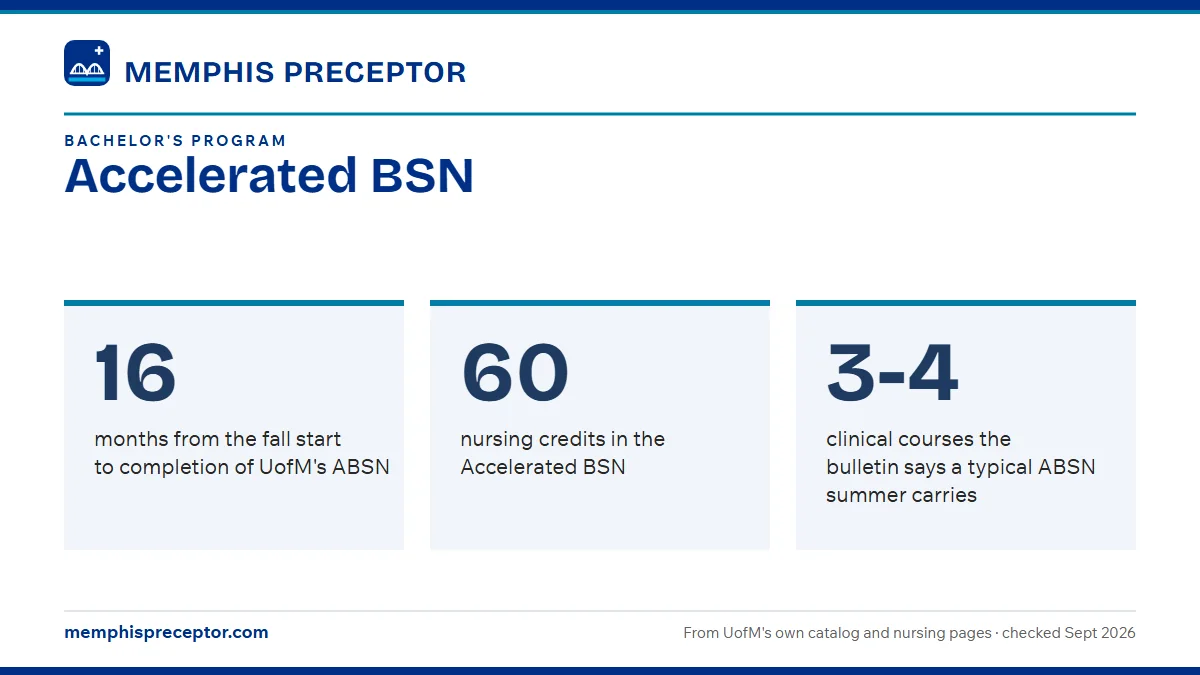
UofM's Accelerated BSN is a 16-month, full-time route into nursing for applicants with a completed bachelor's. It starts only in fall, runs four semesters including one summer term, and uses the same 60-credit nursing major and practicum courses as the Traditional BSN, with clinical sites assigned by the college. We come in afterward, when ABSN graduates move on to graduate study and need preceptors.
Thinking about the MSN after your ABSN?
Share your ABSN finish date and the MSN track you have in mind. A placement advisor walks you through preceptor planning for graduate clinicals.
Sixteen months, from fall to fall
UofM describes the ABSN as a four-semester, full-time program that begins in the fall and includes one summer term. The published plan runs fall, spring, summer and a final fall, and it covers the complete 60-credit nursing major taught in the Traditional BSN, only compressed.
| Semester | Term | Clinical picture |
|---|---|---|
| 1 | Fall | Nursing coursework begins; no practicum course yet |
| 2 | Spring | First practicum courses |
| 3 | Summer, which may include the May-mester | Typically 3 to 4 clinical courses in three to ten weeks |
| 4 | Final fall | The last semester of the plan |
Admission happens once a year, for fall only, with applications accepted from September 15 to February 15. UofM's Accelerated BSN holds full approval on the Tennessee Board of Nursing's school list, and its CCNE accreditation, shared with the other baccalaureate programs, runs to June 30, 2030. The accreditation guide explains both.
The summer term, up close
Summer is where the accelerated pace shows. The college's 2025-26 Academic Bulletin describes an ABSN summer lasting three to ten weeks that typically carries three or four clinical courses. Shifts run 8 or 12 hours on several days each week, Saturdays included.
The summer term is required, not optional. The bulletin says ABSN students must take their summer courses, which may include the May-mester, and a student who does not may be moved to the traditional track. On UofM's 2027 calendar, the Pre-Summer part of term, the May-mester, runs May 10 to 27, and the extended summer term runs May 10 to August 5, so an ABSN summer that includes it can begin within days of spring exams ending.
Plan paid work, childcare and travel for that stretch before the program begins. Placements and their shift times are assigned to you, and a summer with multiple long shifts a week leaves little room for anything else. The academic calendar guide has the full 2026-27 term dates.
Admission: a finished bachelor's and two GPA figures
To apply, you need a completed bachelor's in any field plus the nursing prerequisites, with a prerequisite GPA of 3.0. The science courses must fall within the past five years, the same recency rule the Traditional BSN applies.
UofM's documents disagree on the overall GPA. The ABSN program page and its curriculum plan give 2.75, while the 2026-27 undergraduate catalog gives 3.0. When two UofM sources conflict, the current catalog is the stronger authority, so aim for 3.0 and ask LCON admissions which figure they apply to your cycle before you submit.
Other details are consistent across UofM's pages: a fall start only, full-time study throughout, and the same nursing courses as the four-semester program. Because the program starts only in fall, missing the February 15 deadline means waiting a full year for the next cohort.
Clinical placements come from the college
Like every prelicensure BSN student, an ABSN student does not go looking for clinical sites. LCON assigns placements according to open sites, available faculty and class size, and the bulletin describes a clinical region spanning West Tennessee and North Mississippi. The Traditional BSN page quotes the bulletin's wording and explains how assignments have been described over time.
Two practical points follow. Facility problems carry real weight: a student whom a facility refuses, for whatever reason, may have to withdraw, while one who speaks up before assignments are issued may be offered another site if there is room. And clearance has to be ready early, because the first practicums arrive in only your second semester. Your records live in DISA Complio, each assigned site's onboarding runs through HealthStream myClinicalExchange, and your immunizations, background check and drug screen all have to be accepted first. See the immunizations and BLS guide.
Grades and pace in an accelerated plan
The ABSN runs on the BSN's progression rules. Each nursing course needs at least a C, every course in a sequence has to be complete before the next begins, and a theory course and its clinical partner go back on your schedule together when either one needs a retake. Failing the same course twice, or failing two different nursing courses, ends the program.
Those rules bite harder at accelerated speed. There is no lighter term to recover in, and the bulletin already allows an ABSN student who skips summer courses to be moved to the traditional track. Miss more than a fifth of clinical time without planning it, and the clinical grade becomes unsatisfactory, which in a short summer of long shifts leaves little margin. Treat every clinical day as fixed.
From ABSN to an MSN
If an MSN is your next step after the ABSN, the preceptor question returns at the graduate level. UofM's graduate admission wants proof of current or recent clinical nursing on your resume, plus an RN license with no restrictions, from Tennessee or from an approved state where your clinicals will happen, so your first nursing job matters.
UofM's MSN pairs online coursework with in-person clinicals near home, and each NP track's first precepted practicum is a spring course. Each preceptor agreement form needs the partnerships office's approval before the first clinical day. Whatever part UofM plays in placement then, we bring you a preceptor and a site matched to its rules, built around the rotation requirements of your concentration.
Each NP concentration has its own rotation rules. All three require at least one rotation precepted by a nurse practitioner; FNP needs a family practice rotation, with the residency itself set in internal medicine or family practice; AG-ACNP practicums sit in inpatient and critical care settings; PMHNP moves between outpatient and inpatient psychiatric care. AG-ACNP applicants also need two years' full-time adult critical care or emergency nursing within the three years before admission, which is worth weighing as you choose your first nursing job.
Start with the programs overview to compare the MSN concentrations, then see how we work.
Questions UofM students ask
Can I start UofM's Accelerated BSN in spring?
No. The ABSN admits once a year, for fall only, and the application window runs from September 15 to February 15. If you need a spring start, the Traditional BSN admits in both fall and spring, though it takes four nursing semesters on top of 60 pre-nursing credit hours rather than 16 months.
Is the summer term required in the ABSN?
Yes. The bulletin says ABSN students must take their summer courses, which may include the May-mester, and a student who does not may be moved to the traditional track. The summer typically carries three or four clinical courses, so it is one of the program's most demanding stretches.
How many hours a week are ABSN summer clinicals?
UofM does not publish a weekly figure. The bulletin describes 8- or 12-hour shifts on multiple days a week, Saturdays included, across a summer lasting three to ten weeks. Clock hours per practicum are not published either, so ask your clinical faculty for the schedule once assignments are made.
What GPA does UofM's Accelerated BSN require?
UofM's sources conflict. The ABSN program page and curriculum plan say 2.75, and the 2026-27 undergraduate catalog says 3.0. The prerequisite GPA is 3.0 in both. Aim for 3.0 and confirm the figure with LCON admissions for your application cycle.
How is the ABSN different from the Traditional BSN?
The nursing content is the same 60-credit major, with the same practicum courses and the same assigned clinicals. The ABSN compresses it into 16 months with a required summer, admits only in fall and requires a completed bachelor's. The Traditional BSN runs four nursing semesters after 60 pre-nursing credit hours and admits twice a year.
Related pages
Last checked 2026-09-27
We check these pages against UofM's 2026-27 catalog, the LCON Academic Bulletin, program pages and licensure disclosures. Your clinical faculty and your plan of study have the final word.
Whether UofM helps or you start alone, we find the preceptor.
Tell us your UofM concentration, your next practicum and the town you train near. We find preceptors and sites that fit the course and prepare what the preceptor agreement form needs, early enough for approval before the first clinical day.
- Preceptors matched to the rotation rules: an NP preceptor, family practice for FNP, inpatient and critical care for AG-ACNP
- License, certification and site details ready for the preceptor agreement form, with your Complio items in order
- Across the Mid-South, Tennessee and the states UofM serves
Start your placement plan
Your concentration, your town and your next clinical semester is all we need to begin.