The UofM Traditional BSN: sequences, practicums and assigned clinicals
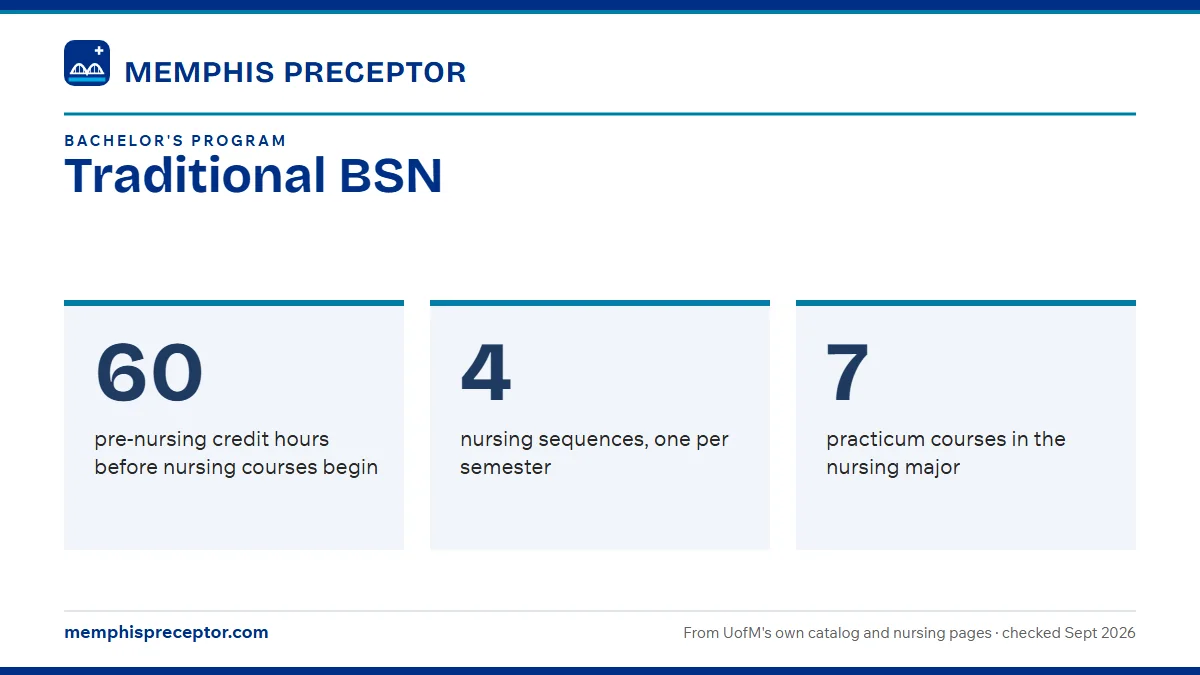
UofM's Traditional BSN adds four semesters of nursing courses to 60 pre-nursing credit hours, taught from a home campus in Memphis or on the Lambuth campus in Jackson. The college assigns the clinical sites for all seven of its practicum courses. Our work begins after graduation, when you move on to an MSN and need a preceptor who fits that program's rules.
Planning past the BSN?
Tell us your graduation term and the MSN track you are weighing. A placement advisor explains how preceptor planning works for graduate clinicals.
How the Traditional BSN is built
The program has two halves. You complete 60 credit hours of pre-nursing coursework first, then a 60-credit nursing major delivered over four semesters that the catalog calls Sequences 1 through 4. In UofM's sample plan, the nursing sequences run from junior fall to senior spring. Some UofM pages word the credit totals in ways that do not add up, so hold on to the clear rule: 60 credit hours before nursing courses begin.
Admission opens twice a year. The fall window runs September 15 to February 15 and the spring window March 15 to September 1, and a freshman pre-admission option, with its own window from September 15 to January 1, holds a nursing seat for students who meet its criteria. Applicants need a 3.0 cumulative GPA and a 3.0 prerequisite GPA, science courses taken within the past five years, and no more than one prerequisite repeated, one time only.
Once in the major, you have four years to finish it. The program is taught on the ground, not online.
Seven practicums across four sequences
The first sequence builds skills in the lab. Practicum courses begin in the second sequence and continue to a capstone in the last one, each paired with the theory course it puts into practice.
| Sequence | Practicum courses | Sequence credits |
|---|---|---|
| 1 | None titled practicum; hands-on work in NURS 3103 Health Assessment Lab and NURS 3106 Foundational Nursing Skills | 14 |
| 2 | NURS 3129 Mental Health Nursing Practicum; NURS 3206 Nursing of the Adult I Practicum; NURS 3219 Childbearing Family Practicum | 15 |
| 3 | NURS 3229 Pediatric Nursing Practicum; NURS 3306 Nursing of the Adult II Practicum; NURS 4129 Community Health Nursing Practicum | 16 |
| 4 | NURS 4206 Transition into Professional Nursing Practice Practicum, the capstone clinical course | 15 |
UofM does not publish clock hours for these practicums, and the catalog prints credit ranges for several of them; the capstone, NURS 4206, is listed at 4 to 8 credits. The fourth sequence also carries two nursing electives chosen from a short list that includes NURS 4108 and NURS 4400 through NURS 4403.
Clinical placements are assigned by the college
Here the BSN parts company with UofM's graduate programs. The LCON Academic Bulletin for 2026-27 states it directly: "Students are assigned clinical placements based on site availability, faculty resources, enrollment, and the number of students requiring placement." The previous edition was blunter, calling the placements random, noting they could fall during days, evenings or weekends, and adding that assignment changes cannot be requested.
Placing students in clinical groups is a duty the faculty handbook assigns to the Director of Undergraduate Programs, supported by an Undergraduate Clinical Placement Coordinator. According to the bulletin, BSN clinical sites span a region covering West Tennessee and North Mississippi, and UofM adds that clinical courses are taught at institutions in each campus's own community.
One rule deserves attention before the first practicum. A student denied placement at a facility for any reason, prior employment or a human resources issue included, may be required to withdraw. Raise a concern like that before assignments go out, and the college may consider you for a different site when one exists, so early disclosure is worth it.
Plan your job and family schedule around assigned clinicals: the college sets the site and the shift, and a changed assignment is not something to count on.
Memphis or Lambuth: choosing a home campus
Traditional BSN students are admitted to a home campus, and you may apply to both. In Memphis, nursing is based in the Community Health Building on the university's South Campus, opened in 2015 and fitted with six debriefing rooms, six simulation suites, a simulated home, and separate labs for skills and health assessment. In Jackson, the Lambuth campus has taught nursing since 2012, and its 2022 home, Sprague Hall, counts seven simulation rooms plus skills labs, debriefing space, its own simulated home and a virtual reality lab.
Your home campus shapes where your clinicals happen, since each campus draws on institutions in its own area. Switching is possible but not simple: a campus transfer request is not reviewed until your first semester ends, and approval is not assured. Choose the campus whose clinical community you can reach week after week.
Rules that decide whether you progress
BSN grading and progression rules are strict, and they apply to practicums as much as to lectures.
- Every nursing course needs a C or better, and every course in a sequence must be finished before the next sequence starts.
- Theory and clinical courses are companions: repeat one and you repeat the other, even if you passed it.
- A nursing course may be attempted only twice. Two grades below C in the same course, or below C in more than one nursing course, lead to academic disqualification.
- Unplanned absences above 20 percent of clinical time bring an unsatisfactory clinical grade.
- Working an 11 p.m. to 7 a.m. shift right before a clinical day is not permitted.
- Missing two fall or spring semesters in a row means applying again.
Clinical sites also need your clearance in place. BSN students keep health and compliance records in DISA Complio and use HealthStream myClinicalExchange for each assigned site's orientation modules and approval status, with a background check and drug screen through approved vendors. Details sit in our guides to background checks and drug screens and to Complio.
After the BSN: planning for graduate clinicals
If an MSN is in your future, that is where a preceptor search enters the picture. Graduate admission at UofM looks for a 3.0 undergraduate GPA, the NCLEX-RN behind you, a statistics course and a resume that reflects recent clinical nursing work. The Adult-Gerontology Acute Care NP concentration asks for more: two years' full-time equivalent in adult critical care or an adult emergency department, all within the three years before admission.
UofM's MSN coursework is online, and the practicums are done in person near where each student lives. In every NP track the first precepted practicum falls in a spring term, and no clinical day starts until the partnerships office has approved a preceptor agreement form. Whether or not UofM takes part in placing you at that stage, we source a preceptor and a site that clear its requirements; that graduate-level process is our specialty.
Compare the FNP, AG-ACNP and PMHNP concentrations, then see how our service works for the graduate years.
Questions UofM students ask
Can UofM BSN students choose their clinical sites?
No. The college makes BSN assignments itself, working from open sites, faculty capacity, enrollment and the size of each group needing a spot. The 2025-26 bulletin described the assignments as random, possibly on days, evenings or weekends, and said changes could not be requested. Raise any employment or facility concern before assignments are made.
Where do UofM BSN clinicals take place?
The bulletin places them at healthcare locations across West Tennessee and North Mississippi. Clinical courses are taught at institutions in each home campus's community, so where you train follows your home campus. Ask your campus's clinical faculty what the usual range of sites looks like.
Can I apply to both the Memphis and Lambuth campuses?
Yes. UofM's FAQ says applicants may apply to both. Once admitted, you belong to a home campus, and a later request to move is not reviewed until your first semester is over and may not be approved. Choose based on where you can attend lab and clinical days reliably for four semesters.
What grade do UofM BSN nursing courses require?
Every nursing course, practicums included, needs at least a C. A nursing course may be taken only twice, and earning below C twice in one course or below C in more than one nursing course ends the program. Companion theory and clinical courses are repeated together if either must be retaken.
When should a BSN graduate start planning NP clinicals?
Earlier than most expect. Every UofM NP track schedules its first precepted practicum for a spring semester, roughly a year into the program for spring entrants and nearly a year and a half for fall entrants. A preceptor for that spring is best secured during the fall before it. The first clinical course guide counts it out by program.
Related pages
Last checked 2026-09-27
We check these pages against UofM's 2026-27 catalog, the LCON Academic Bulletin, program pages and licensure disclosures. Your clinical faculty and your plan of study have the final word.
Whether UofM helps or you start alone, we find the preceptor.
Tell us your UofM concentration, your next practicum and the town you train near. We find preceptors and sites that fit the course and prepare what the preceptor agreement form needs, early enough for approval before the first clinical day.
- Preceptors matched to the rotation rules: an NP preceptor, family practice for FNP, inpatient and critical care for AG-ACNP
- License, certification and site details ready for the preceptor agreement form, with your Complio items in order
- Across the Mid-South, Tennessee and the states UofM serves
Start your placement plan
Your concentration, your town and your next clinical semester is all we need to begin.