UofM's online RN to BSN and its community health clinical
UofM's RN to BSN gives registered nurses 30 nursing credits online through UofM Global, in 7-week courses with starts in fall, spring and summer. One course, NURS 4126 Community Health Nursing, includes direct and indirect patient care, and UofM's public pages do not say how that experience is arranged. Whether UofM helps set it up or not, we find a community health setting that fits the course and prepare what your faculty ask for.
Get ready for NURS 4126
Tell us the term you expect to take NURS 4126 and where you live. A placement advisor replies with community health settings that suit the course.
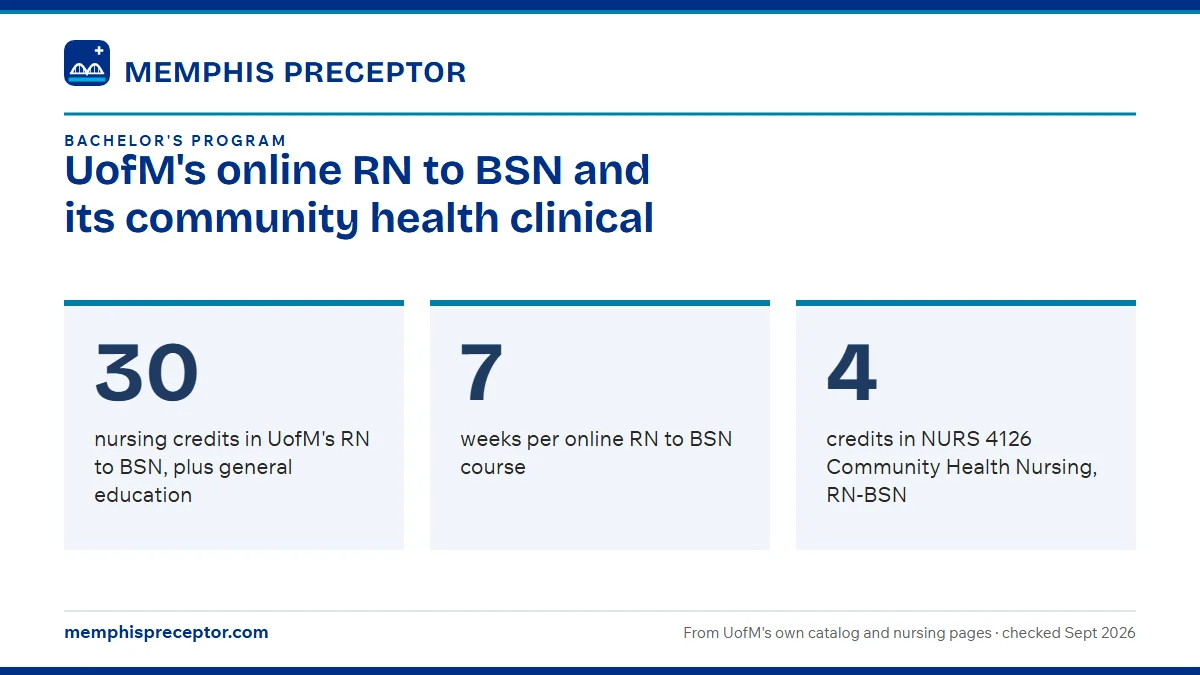
Thirty nursing credits in 7-week online courses
UofM presents the RN to BSN as 100 percent online, in 7-week courses delivered through UofM Global. Along with any UofM general education you still need, the nursing portion is ten courses worth 30 credits.
| Course | Title | Credits |
|---|---|---|
| NURS 3007 | Introduction to Professional Nursing, RN-BSN | 3 |
| NURS 3009 | Pharmacology, RN-BSN | 3 |
| NURS 3109 and 3110 | Health Assessment, RN-BSN, and its lab | 2 + 1 |
| NURS 3401 | Clinical Pathophysiology, RN-BSN | 3 |
| NURS 4108 | Transcultural Nursing in Diverse Populations | 3 |
| NURS 4111 | Evidence-Based Practice and Research, RN-BSN | 3 |
| NURS 4126 | Community Health Nursing, RN-BSN (direct and indirect patient care) | 4 |
| NURS 4207 | Leadership for RNs (indirect patient care leadership project) | 4 |
| NURS 4209 | Professional Portfolio Development | 4 |
Credit by exam is available for health assessment and its lab, for pathophysiology and for pharmacology, which can shorten the list for an experienced nurse. UofM's program page says you could potentially finish in 12 months, while its sample plan lays the courses out over four semesters; your advisor can map the pace that fits your work schedule.
NURS 4126: the course with patient care
Most RN to BSN courses are pure coursework. The exception is NURS 4126 Community Health Nursing, RN-BSN, which the catalog describes this way: "Includes direct and indirect patient care and a teaching project." In UofM's sample plan it falls in the third semester. NURS 4207 Leadership for RNs is the other applied course, built around an indirect patient care leadership project rather than hands-on care.
UofM's public pages stop short of the practical details. They publish no clock hours for NURS 4126, and they do not say who arranges the community health experience. Your course faculty and advisor are the people to ask, ideally a full semester ahead, since UofM wants your health data submitted the semester before your first clinical course.
Whether UofM helps arrange that experience or not, we can find a community or public health setting near you that suits the course, checked against what your course faculty expect, and prepare the details they request so the setting can be reviewed quickly.
Clearance items before the clinical course
UofM lists a set of requirements that have to be in place before NURS 4126 begins. Its sources do not all agree on the details, so check the current list with your advisor.
- A background check.
- American Heart Association BLS certification.
- Immunizations as LCON requires them (immunizations and BLS guide).
- A drug screen no older than 30 days when the clinical course starts. The RN to BSN page calls for a 10-panel screen plus alcohol, while the college FAQ says a 12-panel urine drug screen; follow the current program page and confirm with your advisor (background check and drug screen guide).
- Health data turned in one semester ahead of your first clinical course.
Because the 30-day window is tied to the start of the clinical course, schedule the drug screen in the month before that course starts, not at the start of the program.
Admission, license and where you live
You need an active, unencumbered RN license, or eligibility for one. Nurses who have not yet been licensed may be accepted provisionally, and the catalog gives six months to show proof of licensure. Residents of California cannot enroll.
Admission is continuous, with fall, spring and summer starts, but the deadlines depend on which UofM source you read. The program page lists August 1 for fall, January 1 for spring and June 1 for summer. The printed curriculum plan mentions only fall and spring, and the college FAQ says you may apply any time before the term begins. Treat the program page's dates as the working deadlines and confirm with LCON before you plan around a late application.
Science recency has a similar split: the RN to BSN page and the catalog accept science courses from within seven years, and the FAQ says five.
How 7-week courses fit UofM's calendar
UofM divides each fall and spring into a first half and a second half, each about seven weeks long, which match the RN to BSN's course length. UofM does not state which part of term its RN to BSN courses use, so check your schedule in the registration system each term.
For 2026-27, fall's first half is August 24 to October 9 and its second half October 14 to December 2. The spring halves run January 19 to March 5 and March 15 to April 28, with spring break in between. Summer halves are shorter, June 1 to July 1 and July 6 to August 5, so ask how 7-week courses are scheduled in summer. Every 2026-27 date sits in our academic calendar guide.
RN to BSN, or straight to the MSN?
If a master's is your real goal, UofM offers a second route. RN to MSN works as a way into the MSN, not a program of its own. It starts with three undergraduate LCON courses, NURS 3007, NURS 4111 and NURS 4108, passed at C or above, followed by an application to an MSN concentration. All three come from the RN to BSN course list. Nurses who take it finish with the MSN alone, since the pathway confers no BSN. UofM's RN-to-MSN page names three eligible concentrations while its other pages name five, so confirm the one you want.
Either way, an MSN brings precepted clinicals completed face to face in your home area, plus a preceptor agreement form needing the partnerships office's approval ahead of the first clinical day. Whether UofM helps with that placement or not, we specialize in finding preceptors and sites that meet its rules. The MSN FNP page and the MSN Nursing Education page are good places to compare options.
Why RN to BSN students choose us
Working nurses have little spare time, and we are built to save it. We plan around UofM's own requirements, from the RN to BSN's community health course to the graduate rotations that may follow.
- Community health settings near you that suit
NURS 4126, identified ahead of the term. - Site details set out in the form your faculty request, ready for review.
- A check that your clearance items, including the 30-day drug screen, line up with the course dates.
- Early planning for RN to MSN or a later MSN, including practicum timing and rotation rules.
UofM's faculty decide on your clinical experience; we make sure the information they receive is complete and fits the college's rules. Share your expected NURS 4126 term in the form at the foot of this page, or start with our process.
Questions UofM students ask
Does the UofM RN to BSN include any in-person work?
UofM describes the program as 100 percent online with 7-week courses through UofM Global. The exception to watch is NURS 4126 Community Health Nursing, which includes direct and indirect patient care, so expect a patient care component in that course even though its teaching is online.
How long does UofM's RN to BSN take?
UofM says students can potentially finish in 12 months. Its sample plan spreads the ten nursing courses across four semesters, and credit by exam can cover as many as nine of the 30 nursing credits. Any UofM general education you still owe adds time, so ask your advisor to build your plan before the first term.
Can I start the RN to BSN before I have my RN license?
Yes, if you are eligible for licensure. The catalog allows provisional acceptance for nurses who are eligible for an active, unencumbered license but do not hold it yet. Proof of licensure is due within six months, and California residents cannot enroll at all.
Which RN to BSN courses can I test out of?
UofM offers credit by exam for NURS 3109 Health Assessment and its lab, NURS 3110, for NURS 3401 Clinical Pathophysiology and for NURS 3009 Pharmacology. The rest, including NURS 4126 and the leadership and portfolio courses, are taken as regular 7-week courses.
Is UofM's RN to BSN accredited?
Yes. UofM's baccalaureate nursing programs carry CCNE accreditation that runs to June 30, 2030. On the state nursing board's list of approved schools, the RN-BSN sits beside the Traditional and Accelerated BSN with full approval status. The university itself is accredited by SACSCOC, most recently reaffirmed in December 2025.
Related pages
Last checked 2026-09-27
We check these pages against UofM's 2026-27 catalog, the LCON Academic Bulletin, program pages and licensure disclosures. Your clinical faculty and your plan of study have the final word.
Whether UofM helps or you start alone, we find the preceptor.
Tell us your UofM concentration, your next practicum and the town you train near. We find preceptors and sites that fit the course and prepare what the preceptor agreement form needs, early enough for approval before the first clinical day.
- Preceptors matched to the rotation rules: an NP preceptor, family practice for FNP, inpatient and critical care for AG-ACNP
- License, certification and site details ready for the preceptor agreement form, with your Complio items in order
- Across the Mid-South, Tennessee and the states UofM serves
Start your placement plan
Your concentration, your town and your next clinical semester is all we need to begin.