Grades, repeats and progression in UofM's MSN
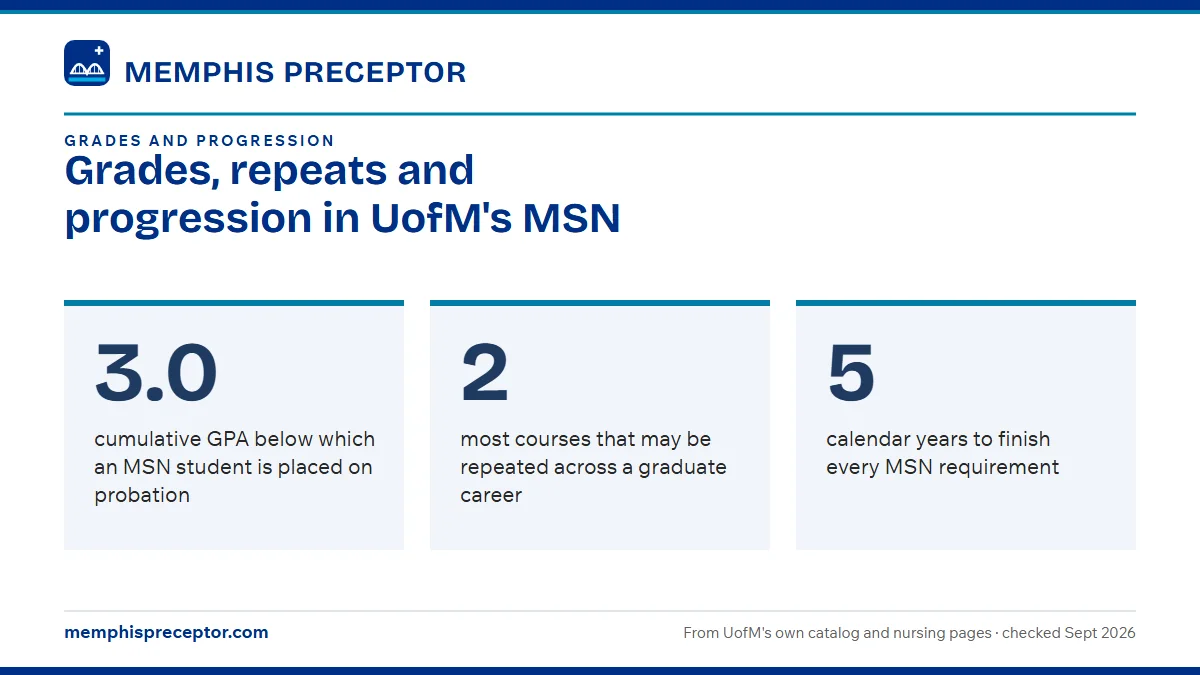
UofM practicum courses require a B or better, and each practicum is tied to companion courses: repeat one and you repeat them together. A cap of two repeats across your graduate career, a 3.0 GPA line and a five-year clock set the remaining limits. This guide gathers the rules from the 2026-27 graduate catalog and the LCON Academic Bulletin and flags where they disagree.
Get your placement plan
Tell us your UofM program and where you live. A placement advisor replies with the preceptor and site options that fit your UofM course.
A B or better in every practicum
On one point every UofM source agrees: practicum courses require a B or better. The Bulletin applies it to all graduate practica, the health assessment lab included, and each practicum description in the 2026-27 catalog repeats that a B is needed to progress. Falling short appears among the Bulletin's grounds for academic disqualification.
Practicums earn letter grades just as didactic courses do. The Bulletin's scale runs A 93 to 100, B 85 to 92, C 77 to 84 and D 70 to 76, with F at 69 and below. Final grades round at the tenths place, so an 84.5 becomes an 85 and a B, while an 84.49 stays a C.
A passing clinical grade also needs progressive improvement across the term and a Satisfactory rating on every core and course competency by its end. The syllabus then sets how the final grade is calculated.
Where UofM's grade rules disagree
For courses outside the practicums, the rule depends on which page you read. The 2026-27 graduate catalog says MSN students must earn a B or better in all courses. The MSN programs page still carries an older rule that allows up to 7 hours of C grades and names the clinical courses needing a B by numbers, several of which UofM has since retired.
The Bulletin sits between the two. C grades earned from Spring 2025 onward do not count toward the MSN, though they still count in your GPA, while up to 7 hours of C in didactic courses taken before Spring 2025 may still apply. Certificate entries split as well: the FNP and Nursing Education certificates ask for a B in clinical and lab courses, and the AG-ACNP, PMHNP and Nursing Leadership certificates ask for a B in all courses.
If you started before Spring 2025, or you already hold a C, ask your faculty advisor which rule governs your plan of study, and keep the answer.
Companion courses move together
UofM pairs each practicum with didactic companion courses in the same semester. The Bulletin requires companions to be taken, and passed, together, and repeating one means repeating its co-requisite even if you did well in it. NURS 7643, for example, runs alongside its FNP I companions NURS 7641 and NURS 7642, as the FNP practicum guide shows.
That pairing is why a placement problem rarely stays small. A preceptor who leaves mid-term, a site whose clearance stalls, or a schedule that runs short of weeks can put a full term of specialty courses at risk at once. It is also why we plan preceptors term by term against your plan of study, and why the backup preceptor guide is worth reading before you need it.
Repeats, probation and disqualification
UofM limits second chances tightly. The Bulletin and catalog set these rules for MSN and certificate students.
- A course may be repeated only after a U or a grade below B, and the repeat must earn a B or better.
- Each course may be repeated once, at its next offering.
- No more than two courses may be repeated in your whole graduate career, and only the second grade counts in the GPA.
- A cumulative GPA below 3.00 means probation, and a second probation semester in a row means academic disqualification.
- Other grounds for disqualification include a grade below B on a repeat, willful misrepresentation of patient data or clinical practice, putting a patient in physical or emotional jeopardy, Board of Nursing probation, losing an unencumbered RN license, an undisclosed felony or board discipline, and missing the five-year limit.
The catalog lists a GPA below 3.0 among its disqualification grounds without describing the probation step, so read it together with the Bulletin. After disqualification, a student may reapply to the MSN after 3 years, or to a graduate certificate after 1 year. Dismissal notices arrive by UofM email.
The residency semester and the five-year clock
Each NP track and each Education or Leadership concentration ends in a Roles and Transition to Practice Residency. Before it, every core and specialty course must be complete, and no course may be repeated during the residency semester. The Programmatic Cumulative Evaluation also takes place in the residency course: NURS 7649, NURS 7629, NURS 7619, NURS 7209 or NURS 7919. The NP residency guide covers the setting rules.
Over all of this runs a limit of five calendar years to finish MSN requirements. A repeat happens at the course's next offering, and with companion courses moving together, one setback can push later terms of your plan of study back with it. The delayed graduation guide looks at how that knock-on effect plays out and how to limit it.
Advising, withdrawal and appeals
Every MSN student has a faculty advisor and is expected to meet at least twice a semester, usually in small groups. After any failing or unsatisfactory clinical grade, and after any grade below B, you must see your advisor, and the college sends no reminder. Advising runs through your UofM email address rather than a personal or work account.
Grade appeals move in a fixed order: the course faculty, then the Senior Associate Dean for Academic Affairs, then the Dean, then the Graduate School. Withdrawal is limited too. MSN students may withdraw from only one course across the whole plan of study unless the Senior Associate Dean and the MSN Program Director approve more, so it is a step to take deliberately. The windows are in the academic calendar guide.
Why UofM students choose us to keep progression on track
A clinical term can go wrong at the placement stage long before any grade is posted: a preceptor who cannot give the hours, a site that clears late, a rotation that misses the track's rules. However your placement at UofM comes about, we find a preceptor and site near you that meet the course's requirements, and we deliver the preceptor agreement details and check your compliance items early enough that your first clinical day is settled.
If a preceptor leaves during the term, we move straight to a replacement that fits the same course, so the practicum and its companions can stay on schedule. Tell us your program and your next practicum with the form below.
Questions UofM students ask
Is a C a failing grade in UofM's MSN?
In a practicum, effectively yes, because practicum courses require a B or better to progress. For other courses, the 2026-27 catalog asks for a B in all courses, and the Bulletin says C grades earned from Spring 2025 onward do not count toward the MSN, though they remain in your GPA. Either way, a C calls for a conversation with your advisor.
How many times can I repeat a course in UofM's MSN?
Once per course, at its next offering, and no more than two courses across your graduate career. A repeat is allowed only after a U or a grade below B, and it must earn a B or better, since a second miss is grounds for disqualification. Only the repeat grade counts in your GPA.
If I fail a practicum, do I retake the didactic course too?
Yes. The Bulletin requires clinical and didactic companion courses to be taken and passed together in the same semester, and repeating one means repeating its co-requisite even if you passed it. Plan the repeat term with your advisor, and line up a preceptor for the repeated practicum early, since the course returns at its next offering.
How long do I have to finish the UofM MSN?
Five calendar years for all MSN requirements, according to the graduate catalog and the Bulletin, and exceeding it is itself a ground for disqualification. The part-time FNP plans run six or seven terms, which leaves some margin, but repeats and gaps in enrollment eat into it faster than most students expect.
What happens to an Incomplete in a UofM graduate course?
If your instructor grants one, it comes with a deadline. Since Spring 2023, graduate students have one major term to clear an Incomplete, by default the last day of the next major term, and an unfinished one turns into an F automatically. Extensions use the Incomplete Grade Extension form, which must be filed before that deadline.
Related pages
Last checked 2026-09-27
We check these pages against UofM's 2026-27 catalog, the LCON Academic Bulletin, program pages and licensure disclosures. Your clinical faculty and your plan of study have the final word.
Whether UofM helps or you start alone, we find the preceptor.
Tell us your UofM concentration, your next practicum and the town you train near. We find preceptors and sites that fit the course and prepare what the preceptor agreement form needs, early enough for approval before the first clinical day.
- Preceptors matched to the rotation rules: an NP preceptor, family practice for FNP, inpatient and critical care for AG-ACNP
- License, certification and site details ready for the preceptor agreement form, with your Complio items in order
- Across the Mid-South, Tennessee and the states UofM serves
Start your placement plan
Your concentration, your town and your next clinical semester is all we need to begin.