The NP residency at UofM: Roles and Transition to Practice
Every UofM nurse practitioner track ends with a Roles and Transition to Practice Residency: NURS 7649 for FNP, NURS 7629 for AG-ACNP and NURS 7619 for PMHNP. It is the heaviest clinical course in each track, it opens only after every other course is done, and it carries the Programmatic Cumulative Evaluation. We line up residency preceptors early, whatever role UofM plays in your placement, so your final term starts on schedule.
Plan your residency
Tell us your track and residency term, and your placement advisor starts on a preceptor who fits UofM's residency rules.
Three residencies, one purpose
Each NP residency is a four-credit course, the largest credit load of any practicum in its track, and it is where UofM expects you to practice closest to the way a new nurse practitioner does. The course numbers and hours differ by track, and only one track names a required setting.
| Track | Course | Credits | Hours | Setting rule in the bulletin |
|---|---|---|---|---|
| FNP | NURS 7649 | 4 | 250 (2024 plan: 240) | Family practice or internal medicine |
| AG-ACNP | NURS 7629 | 4 | 240 | None named; track rules apply |
| PMHNP | NURS 7619 | 4 | 250 | None named; track rules apply |
The graduate certificates in all three NP areas use the same residency courses. The Education and Leadership concentrations borrow the same residency title for their final immersions, covered in the education immersion guide and the leadership immersion guide.
What must be finished before the residency term
UofM treats the residency as the capstone of the plan of study. The residency semester opens only when your core and specialty coursework is finished, and it cannot host a repeat of any course. A practicum that needs a repeat therefore pushes the residency back by at least one offering, which is why an earlier preceptor problem can ripple all the way to graduation. The delayed graduation guide covers what that looks like.
The usual clinical conditions still apply. Your residency preceptor's agreement form must clear LCON's partnerships office before day one. The drug screen falls inside a 30-day window ahead of every fall or spring clinical term, and Complio and myClinicalExchange items have to stay valid through the last residency day. The residency, like every graduate practicum, needs a B or better.
Setting rules and the 60-hour specialty allowance
Only FNP comes with a named setting: its residency belongs in family practice or internal medicine. AG-ACNP and PMHNP residents follow their track's broader rules, including the requirement that a nurse practitioner precept at least one rotation in the sequence.
Inside the residency, a specialty area can claim as many as 60 hours, and only after the Track Coordinator approves it in advance. For an FNP resident, that leaves at least 190 of the 250 hours in family practice or internal medicine. The rule is newer than some students realize: the spring 2025 bulletin allowed up to 20 percent of a semester's clinical time with the clinical coordinator's approval, and the 60-hour version replaced it from the 2025-26 bulletin on.
Returning to an earlier site is also open to NP residents. The rotation rules guide sets these rules beside the ones for earlier practicums.
How the residency is evaluated
UofM places its Programmatic Cumulative Evaluation inside the final residency course of each track. The public documents name it but do not describe its format, so the residency syllabus in Canvas is the place to read the details for your term.
Day-to-day evaluation uses the Student Clinical Evaluation Tool, which faculty and preceptors complete on your clinical performance. Your clinical faculty's last site visit doubles as a performance evaluation, and finishing the course takes a competence judgment from both that faculty member and your preceptor.
That puts real weight on the residency preceptor. A preceptor who knows UofM's evaluation tool is coming, keeps a steady patient load, and gives you room to lead visits makes the final evaluation far less stressful.
Scheduling a 240- or 250-hour term
The residency hours follow the same pacing rules as every UofM practicum. Your schedule goes to clinical faculty for approval at the start of week two, any change needs a written heads-up seven days out, and no residency can be compressed below seven weeks. Breaks and university holidays carry no clinical days unless faculty and administration make other arrangements.
At the seven-week floor, 250 hours means roughly 36 hours of clinical time every week, close to a full-time job on top of any work shifts you keep. Most residents plan a longer stretch of the term. Either way, the preceptor's calendar has to hold that many patient-care hours, so we confirm availability for the full term before we propose anyone. For the full list of pacing rules, see what counts as clinical hours.
How we set up a residency placement
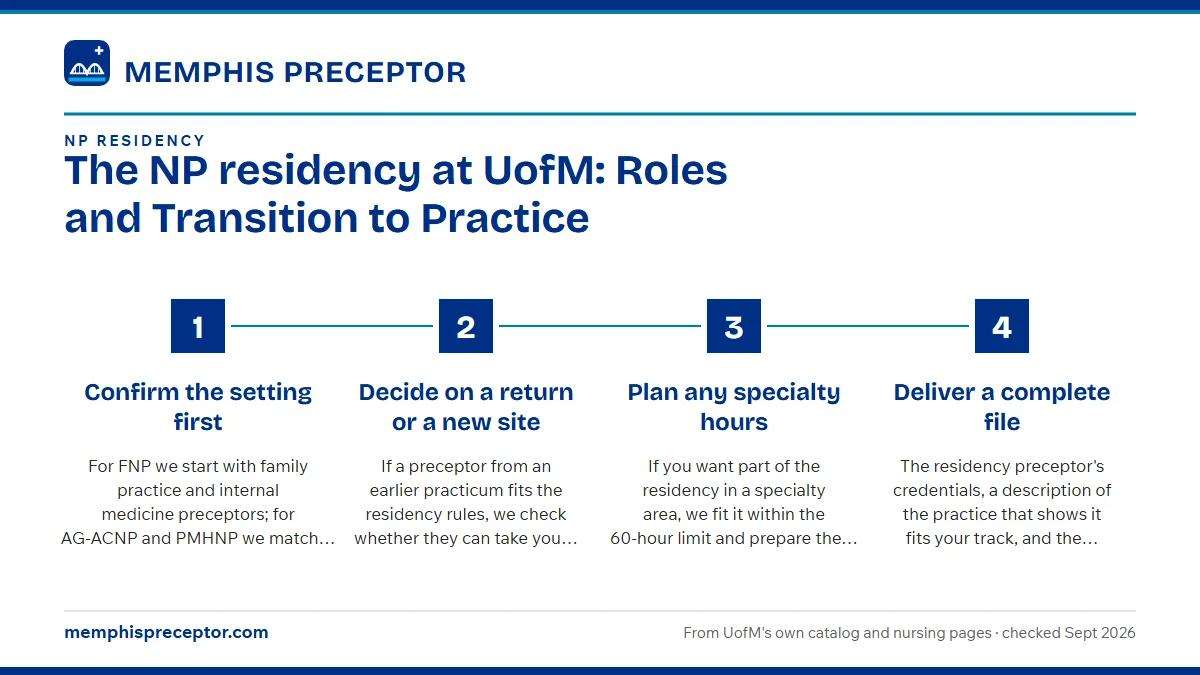
- Confirm the setting firstFor FNP we start with family practice and internal medicine preceptors; for AG-ACNP and PMHNP we match the practice to your track and check that your sequence already includes a nurse practitioner preceptor.
- Decide on a return or a new siteIf a preceptor from an earlier practicum fits the residency rules, we check whether they can take you again; if not, we search for a new one near home.
- Plan any specialty hoursIf you want part of the residency in a specialty area, we fit it within the 60-hour limit and prepare the details your Track Coordinator needs to approve it in advance.
- Deliver a complete fileThe residency preceptor's credentials, a description of the practice that shows it fits your track, and the site's information arrive as one finished packet, weeks ahead of the term.
Approval of a residency preceptor belongs to LCON's partnerships office and your clinical faculty. Our role is to give them a file with nothing missing, so your final term starts when it should. Send us your track and term to begin.
Questions UofM students ask
Can I do my FNP residency in urgent care?
UofM names family practice or internal medicine for the FNP residency, so the bulk of the hours belong in one of those two settings. Any other setting would have to fit within the 60-hour specialty allowance and carry the FNP Track Coordinator's prior approval. Ask before you plan hours outside family practice or internal medicine.
Can I repeat a failed course during my residency semester?
No. Repeats have to happen before the residency semester, at the course's next offering, and the residency follows once everything else is passed. Your faculty advisor can redraw the sequence with you and show how the change moves your expected graduation term, so you can plan work and preceptor time around it.
Do NP certificate students take the same residency?
Yes. The FNP, AG-ACNP and PMHNP graduate certificates include the same residency course as the matching MSN concentration, and the certificate plans keep the same order, so the residency still comes last. The FNP certificate plan runs three terms and the PMHNP plan four, so the residency arrives quickly after admission. See the NP certificates guide for how the certificates are built.
Is the NP residency the same as a post-graduate residency?
No. UofM's Roles and Transition to Practice Residency is a required course inside the MSN or certificate, completed as a student with a preceptor. Post-graduate NP residencies are separate programs for licensed nurse practitioners after graduation, such as the post-graduate PMHNP residency VA Memphis lists on its training page.
Can my residency preceptor be the one I had in an earlier practicum?
Yes, for NP students: the bulletin allows a return to an earlier clinical site for this course. For FNP, the site still has to be family practice or internal medicine. A preceptor who already knows your work can make the evaluation smoother, so it is often worth asking.
Related pages
Last checked 2026-09-27
We check these pages against UofM's 2026-27 catalog, the LCON Academic Bulletin, program pages and licensure disclosures. Your clinical faculty and your plan of study have the final word.
- LCON Academic Bulletin AY 2026-27
- UofM 2026-27 graduate catalog: NURS 7649 FNP Roles and Transition to Practice Residency
- UofM 2026-27 graduate catalog: NURS 7629 AG-ACNP Roles and Transition to Practice Residency
- UofM 2026-27 graduate catalog: NURS 7619 PMHNP Roles and Transition to Practice Residency
Whether UofM helps or you start alone, we find the preceptor.
Tell us your UofM concentration, your next practicum and the town you train near. We find preceptors and sites that fit the course and prepare what the preceptor agreement form needs, early enough for approval before the first clinical day.
- Preceptors matched to the rotation rules: an NP preceptor, family practice for FNP, inpatient and critical care for AG-ACNP
- License, certification and site details ready for the preceptor agreement form, with your Complio items in order
- Across the Mid-South, Tennessee and the states UofM serves
Start your placement plan
Your concentration, your town and your next clinical semester is all we need to begin.