UofM's MSN in Nursing Education, from core courses to residency
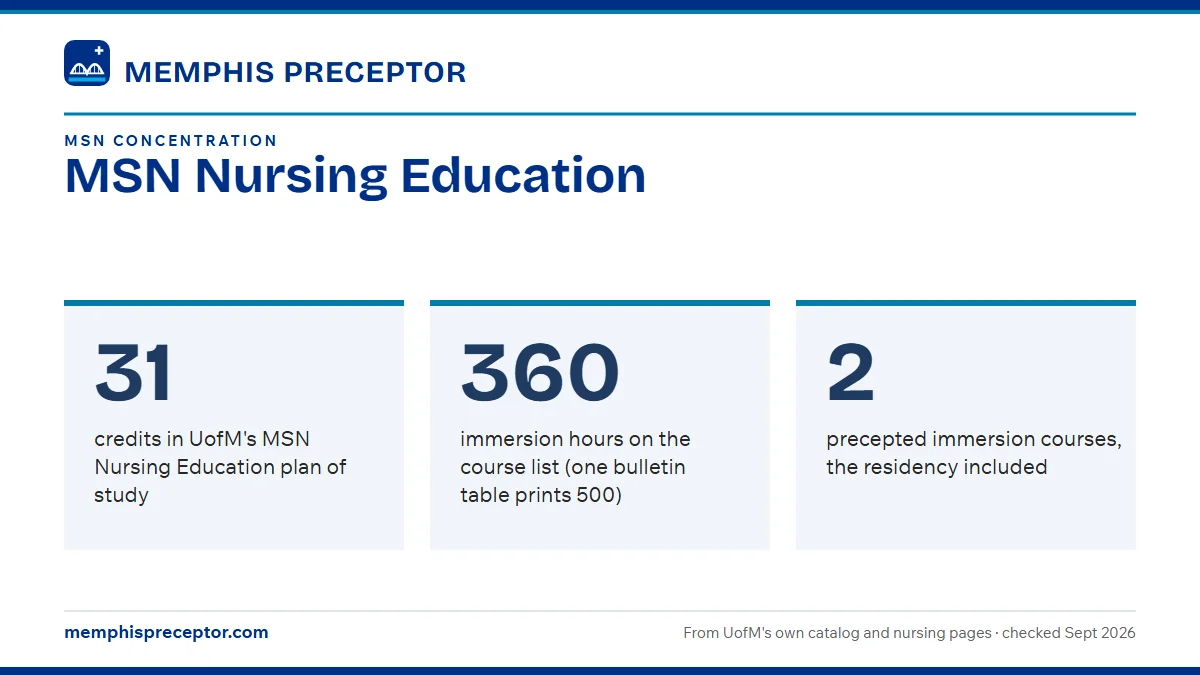
The Loewenberg College of Nursing's Nursing Education concentration is a 31-credit online MSN with a pair of precepted immersions worth 360 hours on the course list. Plans run four terms full time or five to six part time, and a fall starter reaches the first immersion in term two. Whether or not UofM assists with your placement, we line up nurse educator preceptors and sites that satisfy its rules.
Map your education immersions
Give us your start term, your pace and the town you live in. A placement advisor comes back with educator preceptors and sites that suit your plan.
Thirty-one credits: a shared core and a teaching block
All five UofM MSN concentrations open with the same four online core courses, worth 12 credits together. Nursing Education then layers on a 19-credit specialty block that joins advanced practice science, the craft of teaching nurses and two immersions spent beside a preceptor.
| Course | Title | Credits |
|---|---|---|
| NURS 7021 and 7022 | Scholarly Nursing I and II | 6 |
| NURS 7023 | Population Health in Our Global Society | 3 |
| NURS 7024 | Nursing Leadership and Technologies | 3 |
| NURS 7105 | Advanced Assessment, Pharmacology, and Pathophysiology for Nurse Educators | 3 |
| NURS 7106 | The companion lab, which the catalog calls a laboratory practicum | 1 |
| NURS 7204 | Curriculum Design and Educational Theory | 3 |
| NURS 7205 | Evaluation Methods in Nursing Education | 3 |
| NURS 7206 | Teaching Methods for Nurse Educators | 3 |
| NURS 7207 | Nurse Educator Immersion 1 (120 hours) | 2 |
| NURS 7209 | Nurse Educator Immersion II, Roles and Transition to Practice Residency (240 hours) | 4 |
The catalog accepts the nurse practitioner tracks' advanced practice courses, NURS 7101 through NURS 7104, in place of NURS 7105 and its lab. Ask your advisor how that substitution sits in your own plan before you register.
All coursework is delivered online. The immersions are the in-person part of the program, completed with a preceptor at a site in your own area.
Full-time and part-time plans, and where the first immersion lands
UofM publishes Nursing Education plans for both paces and admits students in fall and spring. The full-time plan covers four terms. Part-time study stretches to five terms when you begin in fall, or six when you begin in spring.
In every version, Immersion 1 is a spring course. Begin in fall and NURS 7207 arrives in your second term, only a few months after your first online class; begin in spring and it waits until term four. The residency, NURS 7209, closes the plan, because LCON wants every core and specialty course finished before the residency term and allows no repeats during it.
One scheduling puzzle is worth raising early. The catalog entry for NURS 7207 expects the education courses without a practicum to be done first, yet the published plans schedule it ahead of some of them. The first clinical course guide sets this timing next to UofM's other programs, and your advisor can say which sequence governs your cohort.
The two immersions at a glance
The immersions are where an education student practices the role, and together they total 360 hours: 120 in Immersion 1 and 240 in the residency. The 2025-26 LCON Academic Bulletin's hours table matches that figure for the specialty but lists 500 as the program total, and UofM does not explain the extra 140. Plan around 360 and ask the Education and Leadership track coordinator whether your cohort owes anything more.
One rule belongs to this concentration alone. Nurse practitioner and Leadership students are allowed to reuse an earlier site for the residency; education students are not, so the two immersions always happen in two places. UofM's public pages name no required setting for either course and refer to preceptor qualifications without defining them, which leaves your course faculty's expectations as the guide. Our education immersions guide walks through both courses in detail.
Getting in: GPA, license and the RN-to-MSN route
Direct admission rests on four items: an undergraduate GPA of at least 3.0, NCLEX-RN success, a three-credit undergraduate statistics course and a professional resume or CV that shows you practice clinically now or did so recently. With a GPA of 2.75 to 2.99, the door is two graduate courses taken before admission, and B grades or better in both secure a place.
Registered nurses without a BSN can enter through RN to MSN, an admission pathway rather than a separate program. It asks for three undergraduate courses taken at LCON, NURS 3007, NURS 4108 and NURS 4111, each passed with a C or better, before the MSN application. No BSN is awarded along the way. UofM's RN-to-MSN page lists three concentrations for the route, Nursing Education among them, while its other pages list all five.
The application deadlines are July 1 for a fall start and December 1 for a spring start. Keep your RN license unrestricted, whether it was issued by Tennessee or by the approved state that hosts your immersions. California sits outside LCON's distance education authorization. UofM's documents disagree on which other states qualify, and the state authorization page lays out that conflict.
Rules that apply in each immersion term
A short set of LCON rules governs any term that carries an immersion. Each one has a fuller guide on this site.
- Every practicum needs a B or better, and the 2026-27 catalog extends that B floor to all MSN courses. An older rule on the MSN web page reads differently, so treat the catalog as the deciding source (grades and progression).
- Clinical and didactic companions share a semester: you pass them together, and a repeat of one brings a repeat of the other.
- Before clinical day one, your preceptor agreement form has to be filled in and then cleared by LCON's Office of Community Partnerships and Practice (agreement form guide).
- Your clinical schedule goes to clinical faculty by Monday of the semester's second week, and any change needs written notice a week ahead.
- A course's hours take at least seven weeks, with no clinical days during university breaks or holidays unless faculty arrange them.
- DISA Complio and HealthStream myClinicalExchange must be current, with a background check renewed yearly and a drug screen dated no more than 30 days before a fall or spring clinical term opens (Complio guide).
- Hours at your current employer are allowed only when compelling circumstances prevail and faculty and program administration approve.
Why UofM Nursing Education students choose us
We are specialists in UofM's clinical process, and this concentration rewards planning both immersions as a pair. Our planning begins with your plan of study rather than the week before the term, and it follows the rules above from the first conversation.
- Two sites chosen together, so the residency never lands at your Immersion 1 site.
- Nurse educators near your home, from academic nursing faculty to hospital clinical educators, matched to what your course faculty expect.
- Each preceptor's license, credentials and teaching role set out the way the preceptor agreement form asks, with the site's details beside them.
- Your Complio and myClinicalExchange items checked against each immersion term, the 30-day drug screen window included.
- If a preceptor withdraws, a new search starts that day, aimed at a site you have not used.
Approval of each educator preceptor and site stays with UofM, where clinical faculty and the partnerships office make the call. Our job is to put a file in front of them that is finished, accurate and in line with LCON policy at the first review. Use the form below to share your start term, or see how our process runs.
Questions UofM students ask
How long does UofM's MSN in Nursing Education take?
UofM's full-time Nursing Education plan covers four terms. Part-time students take five terms with a fall entry or six with a spring entry. Whatever the pace, UofM gives MSN students five calendar years to finish every requirement, and sitting out a fall or spring semester triggers a readmission form.
Is the UofM Nursing Education MSN accredited?
UofM's master's nursing programs hold CCNE accreditation running to June 30, 2030, and the state's Board of Nursing gives the university's MSN program tracks full approval. SACSCOC reaffirmed the university's institutional accreditation in December 2025. The accreditation guide explains what each body covers.
What GPA does the Nursing Education MSN require?
The MSN programs page and the 2026-27 catalog set a 3.0 undergraduate GPA. Anyone in the 2.75 to 2.99 band can prove themselves in two graduate courses, and B grades in both lead to admission. The college's FAQ page still mentions 2.8, which is older wording, so follow the catalog.
Can I use NP-track courses instead of NURS 7105 and 7106?
Yes. The catalog accepts NURS 7101 through NURS 7104, the advanced health assessment, pathophysiology and pharmacology sequence from the nurse practitioner tracks, in place of the educator-specific pair. UofM also accepts up to 12 semester hours of transfer credit into the MSN, so ask your advisor how earlier graduate work applies.
Can I start the Nursing Education MSN in spring?
Yes. UofM admits Nursing Education students for fall and spring, with applications due July 1 and December 1. A spring start moves Immersion 1 to your fourth term, which leaves more time to line up an educator preceptor than a fall start, where it arrives in your second term.
Related pages
Last checked 2026-09-27
We check these pages against UofM's 2026-27 catalog, the LCON Academic Bulletin, program pages and licensure disclosures. Your clinical faculty and your plan of study have the final word.
Whether UofM helps or you start alone, we find the preceptor.
Tell us your UofM concentration, your next practicum and the town you train near. We find preceptors and sites that fit the course and prepare what the preceptor agreement form needs, early enough for approval before the first clinical day.
- Preceptors matched to the rotation rules: an NP preceptor, family practice for FNP, inpatient and critical care for AG-ACNP
- License, certification and site details ready for the preceptor agreement form, with your Complio items in order
- Across the Mid-South, Tennessee and the states UofM serves
Start your placement plan
Your concentration, your town and your next clinical semester is all we need to begin.