AG-ACNP practicums at UofM: inpatient and critical care
UofM's Adult-Gerontology Acute Care NP track has four precepted courses: three practicums, NURS 7622, NURS 7624 and NURS 7626, and then the NURS 7629 residency. Each practicum puts you beside a preceptor whose work reaches hospital patients, and UofM's own documents give two different hour totals. However your placement comes together at UofM, we find acute care preceptors who match each course and prepare their details before the term.
Plan your acute care rotations
Share your start term and home area, and your placement advisor starts on the first AG-ACNP practicum.
Four precepted courses, three practicums and a residency
Each AG-ACNP practicum pairs with a three-credit didactic course at the same level: NURS 7621 with NURS 7622, NURS 7623 with NURS 7624, and NURS 7625 with NURS 7626. LCON pairs them for good: you pass both in the same semester, or you repeat both.
| Course | Title | Credits | Hours: plan of study | Hours: 2026-27 bulletin |
|---|---|---|---|---|
| NURS 7622 | AG-ACNP I Practicum | 3 | 180 | 170 |
| NURS 7624 | AG-ACNP II Practicum | 3 | 180 | 170 |
| NURS 7626 | AG-ACNP III Practicum | 3 | 180 | 170 |
| NURS 7629 | AG-ACNP Roles and Transition to Practice Residency | 4 | 240 | 240 |
The catalog course pages for these practicums say a B or better is needed to progress. The residency has its own guide, the NP residency, which covers the rules for the final clinical term in all three NP tracks.
NURS 7622: where acute care begins
The 2026-27 catalog pairs AG-ACNP I with a preceptor "whose practice includes inpatient care," and it lets that work take place in a clinic, a hospital or a critical care unit. Read closely, that wording is broader than many students expect. A clinic-based preceptor can work for this first course, as long as that preceptor's practice also reaches hospital patients.
In practice, that points to groups whose providers see patients in an office and also round on inpatients, alongside hospitalist and critical care teams. Your clinical faculty decide whether a given practice fits, so we share the preceptor's inpatient role in plain terms when we prepare the file.
Spring is when NURS 7622 arrives on the part-time plan of study: fifth term for a fall entrant, fourth for a spring entrant. That makes the fall before it the time to have a preceptor settled, and it is the first precepted course of the track.
NURS 7624 and NURS 7626: sicker patients, tighter settings
The next two practicums narrow the setting. The catalog frames AG-ACNP II around "acute/critical presentations of medical, surgical, and traumatic illnesses," and AG-ACNP III around hospitalist or intensivist practice and acute or critical presentations. The plan of study puts AG-ACNP II in a summer term, when the seven-week minimum for a course's hours leaves less room to recover lost shifts.
For these courses we look at hospitalist services, intensive care units, and surgical and trauma teams whose providers can take a student for the whole run of the course. Hospital files often involve the most steps, so we open them first.
One mix rule spans the track: somewhere across these courses, a nurse practitioner has to be your preceptor. The rotation rules guide sets that rule beside the FNP and PMHNP versions.
750 or 780 hours: reading UofM's AG-ACNP numbers
The 2026-27 catalog sets the AG-ACNP minimum at 750 clock hours. The part-time plan of study and the 2025-26 bulletin list 180 hours in each practicum plus 240 in the residency, which adds up to 780. The 2026-27 bulletin lists 170 in each practicum plus 240, which lands on 750. Both totals appear in current UofM documents, so treat this as an open conflict.
One course list on the MSN page adds a second wrinkle. It files the AG-ACNP courses under a heading for family nurse practitioner specialty courses and numbers the residency NURS 7649, the FNP number. The catalog uses NURS 7629, and the catalog is the source to trust for course numbers.
The safe plan is a preceptor schedule with room for 180 hours per practicum, then a check with your clinical faculty on the figure for your cohort. The NP clinical hours guide sets these figures beside the other NP tracks.
Hospitals and their paperwork clocks
Acute care sites usually run formal student processes, and each has its own timing. Regional One Health requires affiliation agreements to be signed and executed before any preceptorship or clinical rotation begins. Baptist Memorial's graduate preceptorship form has to be filed a full three months before you would begin. It lists every preceptor by full legal name with contact details, takes one submission per preceptor, and ends with Baptist administration's approval.
UofM adds its own layer. HealthStream myClinicalExchange is where you complete site orientation modules and upload documents for clinical partners, and a site's clearance holds until each item is accepted. Documents cannot expire during the placement, which matters for AG-ACNP students because the catalog also asks you to keep ACLS current throughout the program. The myClinicalExchange guide walks through the site side.
How we set up your AG-ACNP placements
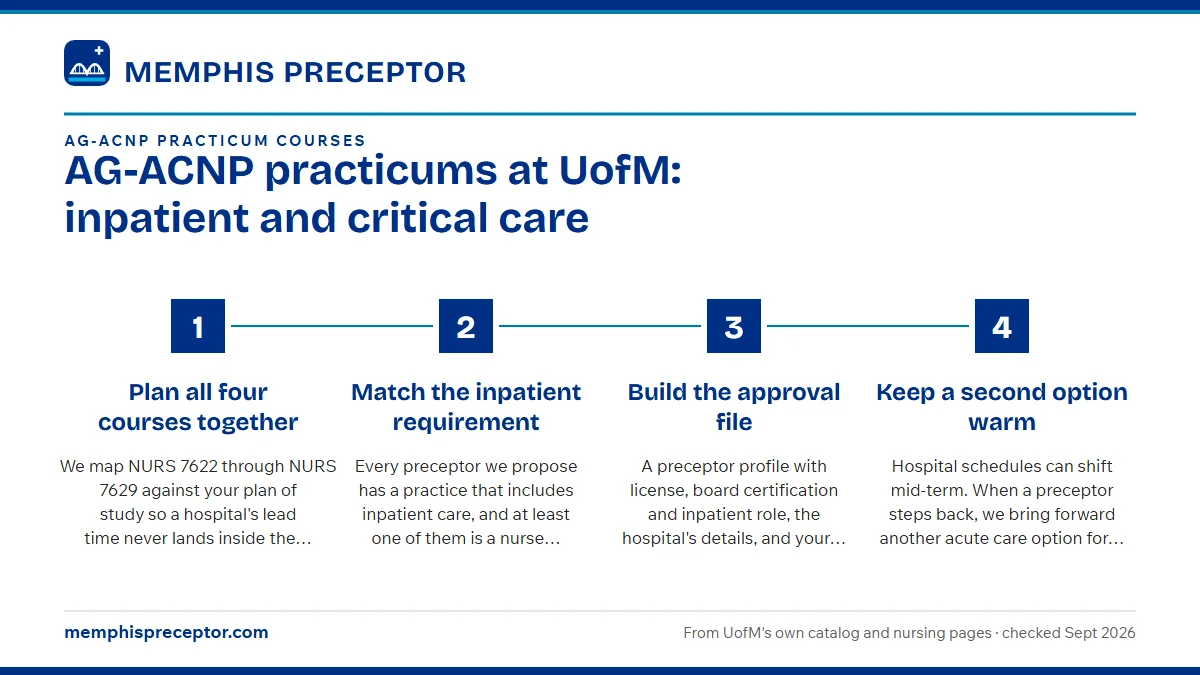
- Plan all four courses togetherWe map NURS 7622 through NURS 7629 against your plan of study so a hospital's lead time never lands inside the term that needs it.
- Match the inpatient requirementEvery preceptor we propose has a practice that includes inpatient care, and at least one of them is a nurse practitioner, so the track rule is covered early.
- Build the approval fileA preceptor profile with license, board certification and inpatient role, the hospital's details, and your ACLS, BLS, Complio and myClinicalExchange dates all go into one package for review.
- Keep a second option warmHospital schedules can shift mid-term. When a preceptor steps back, we bring forward another acute care option for the same course and help you put the site change in writing.
Every AG-ACNP preceptor still needs sign-off from UofM's clinical faculty and partnerships office. We make that review easy with a file that already answers the inpatient and NP questions. Send us your plan and NURS 7622 comes first.
Questions UofM students ask
Does UofM require on-campus intensives for AG-ACNP students?
Yes. AG-ACNP students attend up to three short on-campus intensives, each posted well in advance. Every NP track must attend in January 2027, and UofM's schedule marks more sessions as mandatory for AG-ACNP than for FNP or PMHNP. See the campus intensives guide and plan preceptor days around them.
Can I complete AG-ACNP hours in the unit where I work?
Only in exceptional cases. The bulletin bars practicum hours at your current employer unless compelling circumstances prevail, and then faculty and program administration must sign off and keep a record. AG-ACNP students all arrive with critical care or emergency experience, so the question comes up often. Raise it with your clinical faculty before planning around your own unit.
Does the AG-ACNP graduate certificate use the same practicums?
Yes. The certificate uses the same practicum and residency courses, and the hour conflict carries over: the 2025-26 bulletin lists 780 hours for it and the 2026-27 bulletin 750. UofM has not posted a separate AG-ACNP certificate plan of study, so the term order for certificate students is not public. Ask your advisor for your sequence and see the NP certificates guide.
Can a physician precept an AG-ACNP practicum at UofM?
The track's one published preceptor rule is that a nurse practitioner covers at least one AG-ACNP rotation. Beyond that, UofM lists no qualifications such as years in practice or certification, so the preceptor agreement review by the partnerships office and your clinical faculty decides each case. Ask before you commit to a mix of preceptors.
Can one preceptor cover more than one AG-ACNP practicum?
Under the current bulletin, NP students may go back to an earlier site for the residency, and it publishes no rule against one preceptor covering two practicums. The course descriptions do shift, though, from a practice that includes inpatient care toward hospitalist, intensivist and critical presentations, so one preceptor may not fit every course. Your clinical faculty confirm the fit for each term.
Related pages
Last checked 2026-09-27
We check these pages against UofM's 2026-27 catalog, the LCON Academic Bulletin, program pages and licensure disclosures. Your clinical faculty and your plan of study have the final word.
Whether UofM helps or you start alone, we find the preceptor.
Tell us your UofM concentration, your next practicum and the town you train near. We find preceptors and sites that fit the course and prepare what the preceptor agreement form needs, early enough for approval before the first clinical day.
- Preceptors matched to the rotation rules: an NP preceptor, family practice for FNP, inpatient and critical care for AG-ACNP
- License, certification and site details ready for the preceptor agreement form, with your Complio items in order
- Across the Mid-South, Tennessee and the states UofM serves
Start your placement plan
Your concentration, your town and your next clinical semester is all we need to begin.