UofM's NP clinical hours, and why the totals differ
Plan on at least 750 clock hours in any UofM nurse practitioner track, the floor stated in the 2026-27 graduate catalog and the LCON Academic Bulletin. The 730 and 720 that some FNP students see come from older plan sheets, and the 780 for AG-ACNP comes from a plan of study that gives each practicum ten more hours than the current Bulletin. Below, each figure is matched to the document it lives in and to the person who settles it.
Get your placement plan
Tell us your UofM program and where you live. A placement advisor replies with the preceptor and site options that fit your UofM course.
The short answer for each NP track
Five figures circulate for UofM's three NP tracks. Most of the confusion comes from older PDFs that UofM still links, sitting next to newer catalog entries. The table sorts them out.
| Track | Figure | Where it appears | How to read it |
|---|---|---|---|
| FNP (MSN) | 750 | 2026-27 graduate catalog; LCON Academic Bulletin; 2025 part-time plan (250 + 250 + 250) | Current; plan on it |
| FNP (MSN) | 730 | 2024 FNP curriculum sheet (250 + 240 + 240), still linked from the Programs and Admissions page | Older sheet, below the catalog floor |
| FNP certificate | 750 or 720 | One certificate plan lists 250 per course; the plan linked from the certificates page lists 240 per course | Conflict; confirm before scheduling |
| AG-ACNP (MSN and certificate) | 750 or 780 | Catalog minimum and 2026-27 Bulletin (three at 170 plus 240) against the part-time plan (three at 180 plus 240) | Conflict; arrange preceptor time for 780 |
| PMHNP (MSN and certificate) | 750 | Plan of study and Bulletin table (120 + 190 + 190 + 250) | Consistent |
Each conflict gets its own section below, with the trail of documents behind it. The number you plan around decides how many hours each preceptor must be able to give, so it is worth settling before anyone signs a preceptor agreement form.
FNP: 750 is the figure to plan around
The 2026-27 graduate catalog entry for the FNP concentration states a minimum of 750 clock hours and cites the NTF criteria behind it. The LCON Academic Bulletin repeats 750 for nurse practitioner students as the amount that meets the academic and practicum requirement for national certification.
The 2025 part-time plan of study shows how the 750 divides: 250 hours in NURS 7643, the FNP I acute problems practicum; 250 in NURS 7646, the FNP II chronic problems practicum; and 250 in NURS 7649, the Roles and Transition to Practice Residency. These three documents agree with one another and are the newest UofM publishes for the track. The FNP practicum guide covers what each course asks of you and your preceptor.
Where 730 and 720 come from
The 730 total sits on the 2024 FNP curriculum sheet. It gives NURS 7643 its 250 hours but lists the chronic practicum and the residency at 240 each. The Programs and Admissions page still links that sheet, which is how many students find it. It predates the 2025 plan and falls below the catalog's stated minimum.
The 720 total belongs to the certificate side. The FNP certificate plan linked from the graduate certificates page lists 240 hours in each of the three courses, while a second FNP certificate plan, linked from the Programs and Admissions page, shows 250 each. Certificate students therefore meet two totals for the same three courses. The catalog's certificate entry states the same 750 minimum, and the Bulletin lists 750 for the MSN and the certificate alike, so treat 720 as an outdated sheet unless your FNP track coordinator tells you otherwise.
A preceptor schedule built for 730 or 720 hours comes up short of the catalog's 750-hour minimum. Build every FNP plan on 750.
AG-ACNP: 750 in the catalog, 780 on the plan
AG-ACNP has a split of its own. The graduate catalog requires a minimum of 750 clock hours, and the 2026-27 Bulletin reaches exactly that with 170 hours in each of NURS 7622, NURS 7624 and NURS 7626 plus 240 in the NURS 7629 residency. The part-time plan of study, like the 2025-26 Bulletin before it, gives each of the three practicums 180 hours, which totals 780.
A third document muddies it further. The AG-ACNP course list PDF places the courses under a Family Nurse Practitioner heading and numbers the residency NURS 7649, which is the FNP residency's number. The catalog and Bulletin use NURS 7629, so register by the catalog. Ask your AG-ACNP track coordinator whether each practicum runs 170 or 180 hours before a preceptor commits to a term's schedule; the AG-ACNP practicum guide covers the inpatient and critical care settings.
PMHNP: the one total every source shares
PMHNP is the steady track. The plan of study, the Bulletin's table and the catalog all land on 750: 120 hours in NURS 7612, the advanced mental health assessment and diagnosis practicum; 190 in NURS 7614, focused on outpatient settings; 190 in NURS 7616, focused on inpatient settings; and 250 in the NURS 7619 residency.
The PMHNP paperwork has other quirks, including credit totals that change from one document to the next, but the hours hold steady. That turns PMHNP planning into a question of settings rather than arithmetic: an outpatient psychiatric preceptor for one term, an inpatient one for another, and at least one nurse practitioner among them. The PMHNP practicum guide walks through each course.
How to settle the number for your plan of study
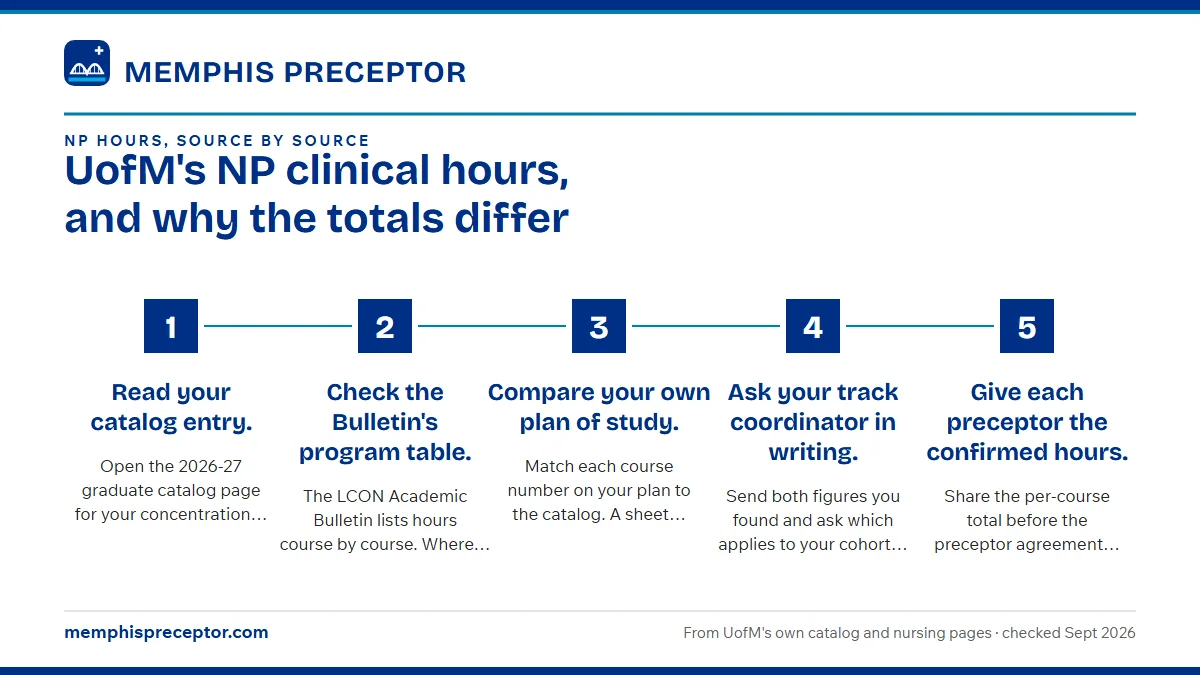
When two UofM documents disagree, the 2026-27 catalog and the current LCON Academic Bulletin come first, and your track coordinator settles anything they leave open. A short sequence keeps it simple.
- Read your catalog entry. Open the 2026-27 graduate catalog page for your concentration or certificate. Its stated minimum is the floor UofM holds you to.
- Check the Bulletin's program table. The LCON Academic Bulletin lists hours course by course. Where it differs from a plan sheet, it is the newer college document.
- Compare your own plan of study. Match each course number on your plan to the catalog. A sheet with 240-hour FNP courses, or a residency carrying another track's number, is a sign to ask.
- Ask your track coordinator in writing. Send both figures you found and ask which applies to your cohort. Keep the reply with your clinical records.
- Give each preceptor the confirmed hours. Share the per-course total before the preceptor agreement form goes in, so the schedule you hand clinical faculty in week two already covers it.
Why FNP students choose us for their 750 hours
The 750 FNP hours run through three courses with different setting rules: acute problems in primary care, chronic problems in primary care, and a residency in family practice or internal medicine. Across them, at least one rotation has to be in family practice and at least one precepted by a nurse practitioner. We plan the three together, so each preceptor knows the hours and setting the course needs before the term opens.
Whatever role UofM plays in your placement, we find preceptors close to home who meet those rules, confirm each one can give the full 250 hours inside the term, and prepare the license, certification and practice details the preceptor agreement form asks for. If a preceptor drops partway through, we move quickly on a replacement for the same course; the preceptor dropped out guide explains what happens next. Tell us your start term with the form below.
Questions UofM students ask
How many hours a week does a 250-hour UofM practicum take?
UofM sets no weekly figure, but the arithmetic helps. Squeezed into the seven-week minimum, 250 hours means about 36 hours a week. Spread over a full Fall or Spring term of roughly 14 weeks, it is closer to 18 a week, before subtracting university breaks and holidays, which are off limits for clinical days unless faculty arrange it.
Do AG-ACNP students need 780 hours to finish?
The catalog's minimum is 750, and the 2026-27 Bulletin's course hours add to 750. The part-time plan of study adds to 780. Until your track coordinator confirms your cohort's figure, arrange preceptor time for 180 hours in each practicum. Finishing a course with spare capacity is far easier than finding extra hours in its final weeks.
Are the FNP certificate hours the same as the MSN?
The courses are identical: NURS 7643, NURS 7646 and NURS 7649. One certificate plan lists 250 hours in each, for 750, and the plan linked from the certificates page lists 240 in each, for 720. The catalog's certificate entry states the 750 minimum, so plan on 750 and confirm with the FNP track coordinator.
Can specialty hours count toward the 750?
Within limits. In the final residency semester, a nurse practitioner student may spend up to 60 hours in a specialty area of practice, and only with the track coordinator's prior approval. The rest of the residency stays in the track's required setting, which for FNP is family practice or internal medicine. The rotation rules guide has the details.
Is 750 hours enough for national certification?
UofM's Bulletin describes its 750-hour minimum as meeting the academic and practicum requirement for national certification, and the catalog ties the figure to the NTF criteria. Certifying bodies publish their own eligibility rules, so read your certifying body's current requirements alongside your plan of study before you apply to sit the exam.
Related pages
Last checked 2026-09-27
We check these pages against UofM's 2026-27 catalog, the LCON Academic Bulletin, program pages and licensure disclosures. Your clinical faculty and your plan of study have the final word.
Whether UofM helps or you start alone, we find the preceptor.
Tell us your UofM concentration, your next practicum and the town you train near. We find preceptors and sites that fit the course and prepare what the preceptor agreement form needs, early enough for approval before the first clinical day.
- Preceptors matched to the rotation rules: an NP preceptor, family practice for FNP, inpatient and critical care for AG-ACNP
- License, certification and site details ready for the preceptor agreement form, with your Complio items in order
- Across the Mid-South, Tennessee and the states UofM serves
Start your placement plan
Your concentration, your town and your next clinical semester is all we need to begin.