UofM's PMHNP practicums: assessment, outpatient, inpatient, residency
Psychiatric-Mental Health NP students at UofM complete 750 clinical hours across four courses that build in a set order: a lifespan assessment practicum, an outpatient practicum, an inpatient practicum, then the residency. Each stage calls for a different kind of psychiatric practice, which is why planning all four together pays off. Whether UofM plays a part in your placement or not, we find mental health preceptors who fit every stage and prepare their details early.
Plan your PMHNP practicums
Tell us your start term and home area, and your placement advisor maps outpatient and inpatient preceptors to your plan.
The four PMHNP courses in order
Three of the four practicums run beside a three-credit didactic partner: NURS 7611 Advanced Mental Health Assessment and Diagnosis with NURS 7612, NURS 7613 PMHNP I with NURS 7614, and NURS 7615 PMHNP II with NURS 7616. NURS 7610 Psychopharmacology rounds out the specialty coursework.
| Course | Title | Credits | Hours | Focus |
|---|---|---|---|---|
| NURS 7612 | Advanced Mental Health Assessment and Diagnosis Practicum | 2 | 120 | Assessment and diagnosis across the lifespan |
| NURS 7614 | PMHNP I Practicum | 3 | 190 | Outpatient settings |
| NURS 7616 | PMHNP II Practicum | 3 | 190 | Inpatient settings |
| NURS 7619 | PMHNP Roles and Transition to Practice Residency | 4 | 250 | Final clinical term |
Unlike the FNP and AG-ACNP tracks, the PMHNP hour counts line up across UofM's documents at 750. The 2026-27 bulletin has no separate PMHNP MSN table, but its certificate table uses the same four courses and the same hours. Every PMHNP practicum description in the catalog requires a B or better to progress, and a repeat of one course brings its didactic partner back with it.
NURS 7612: assessment and diagnosis across the lifespan
The first PMHNP practicum is the shortest at 120 hours, and the catalog places it "in the practice of a supervising preceptor." Its subject is psychiatric assessment and diagnosis across the lifespan, so the best preceptor for this course is one who evaluates children and adolescents as well as adults. Intake-heavy practices give you the most diagnostic interviews per week.
The plan of study slots NURS 7612 into spring: the fifth term for students who began in fall, the fourth for those who began in spring. The PMHNP certificate admits in spring only and puts NURS 7612 in the very first term, so certificate students have almost no gap between admission and clinical work. The first clinical course guide compares that timing with the other UofM programs.
At the seven-week floor UofM sets for any course's hours, 120 hours works out to roughly 17 a week. Most students spread it further across the term.
NURS 7614: the outpatient practicum
PMHNP I carries 190 hours with a catalog focus on outpatient settings, and the plan of study places it in a summer term. This is where you manage ongoing psychiatric care: follow-up visits, medication management and treatment plans that change over months.
Strong outpatient fits include community mental health centers, private psychiatric practices, and behavioral health services inside primary care or federally qualified health centers. Summer terms are shorter than fall and spring, and UofM keeps clinical days off university holidays unless faculty arrange otherwise, so a preceptor with a predictable weekly clinic helps you reach 190 hours without crowding.
If you work in outpatient mental health now, note UofM's employer rule: hours at your current workplace need compelling circumstances plus faculty and program administration approval. The workplace clinicals guide explains how that request works.
NURS 7616: the inpatient practicum
PMHNP II also carries 190 hours, and the catalog shifts its focus to inpatient settings: psychiatric units in general hospitals, freestanding psychiatric hospitals and similar acute programs. Patients arrive in crisis and the preceptor's day moves quickly, which makes this course the one where a well-matched preceptor matters most.
Inpatient sites also bring the most paperwork. LCON's bulletin warns that a site's contract with the college can add or alter requirements, and HealthStream myClinicalExchange holds each site's orientation modules and document uploads. A site will not clear you until each item there is accepted, and anything due to lapse mid-placement has to be renewed first. The myClinicalExchange guide covers that side in full.
Hospital systems in the region also keep their own graduate student timelines. Baptist Memorial, for one, wants a graduate preceptorship application three months before the proposed start, so we open inpatient files before any other.
The residency and UofM's NP preceptor rule
NURS 7619, the PMHNP Roles and Transition to Practice Residency, is the last and longest course at 250 hours. It opens only once all core and specialty coursework is behind you, and it holds the Programmatic Cumulative Evaluation. Going back to an earlier site is allowed, and a specialty area can take as many as 60 of the hours if the Track Coordinator signs off beforehand. The NP residency guide covers the rest.
Somewhere in the four courses, a nurse practitioner has to serve as your preceptor. UofM Global describes the track's preceptors as qualified mental health preceptors but publishes no further qualifications, so each preceptor is vetted when LCON's partnerships office reviews the agreement form. The rotation rules guide compares the PMHNP rule with the other tracks.
How we plan all four PMHNP placements
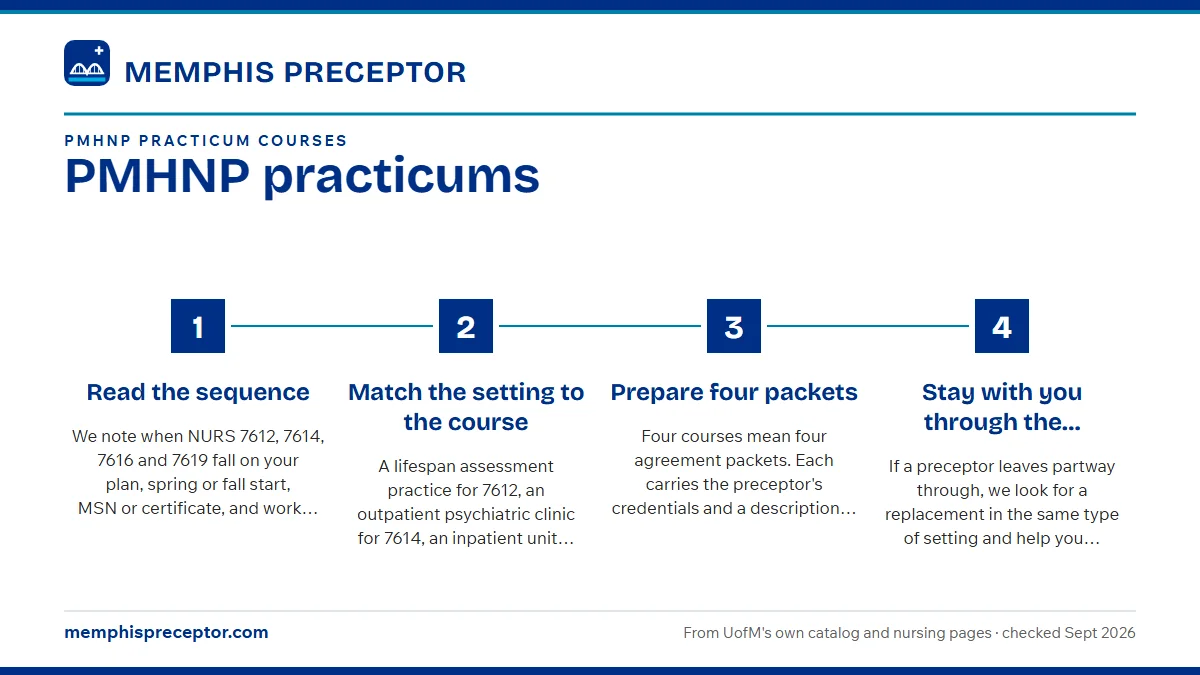
- Read the sequenceWe note when NURS 7612, 7614, 7616 and 7619 fall on your plan, spring or fall start, MSN or certificate, and work backward from each start date.
- Match the setting to the courseA lifespan assessment practice for 7612, an outpatient psychiatric clinic for 7614, an inpatient unit for 7616, and a residency preceptor who can carry 250 hours, with a psychiatric nurse practitioner in at least one of the four.
- Prepare four packetsFour courses mean four agreement packets. Each carries the preceptor's credentials and a description of the psychiatric practice, plus the site's information, with your compliance items checked against every start date.
- Stay with you through the residencyIf a preceptor leaves partway through, we look for a replacement in the same type of setting and help you document the change for approval.
LCON's partnerships office and your clinical faculty hold the approvals. Our work is to put a finished, rule-ready file in front of them for each of the four courses. Send your plan of study to get started.
Questions UofM students ask
Do UofM PMHNP students need child and adolescent patients?
The assessment practicum, NURS 7612, covers psychiatric assessment and diagnosis across the lifespan. UofM does not publish a separate child and adolescent hour minimum, so the safest plan is a preceptor who sees younger patients during 7612 or later in the sequence. Ask your clinical faculty how your cohort handles it before that term.
Can a psychiatrist precept a UofM PMHNP rotation?
UofM names one requirement: a nurse practitioner precepts at least one PMHNP rotation. For the remaining rotations the bulletin lists no published qualifications, so the preceptor agreement review settles each case. Check with your clinical faculty before you build a sequence around a physician preceptor, and keep the NP rotation in the plan either way.
Does the PMHNP certificate follow the same clinical sequence?
Yes. The PMHNP graduate certificate uses the same four precepted courses and the same 750 hours. Its plan admits students in spring only and places NURS 7612 in the first term, which means lining up the first preceptor almost as soon as you are admitted. See the NP certificates guide for entry rules.
Do PMHNP students come to campus?
Yes, a few times. NP students attend up to three short on-campus intensives, and UofM posts each one at least six months ahead. PMHNP students must attend the January 2027 session, which UofM made mandatory across the NP tracks. Keep preceptor days clear of those dates, and check the MSN page for each session's status.
What if a PMHNP placement falls through mid-term?
Switching sites takes written sign-off from both your clinical faculty and the clinical coordinator, and missing clinical without approval means failing the course. Tell your faculty right away, keep your hours documented, and get the new preceptor's paperwork moving. We begin looking for a replacement in the same kind of setting the day you tell us.
Related pages
Last checked 2026-09-27
We check these pages against UofM's 2026-27 catalog, the LCON Academic Bulletin, program pages and licensure disclosures. Your clinical faculty and your plan of study have the final word.
Whether UofM helps or you start alone, we find the preceptor.
Tell us your UofM concentration, your next practicum and the town you train near. We find preceptors and sites that fit the course and prepare what the preceptor agreement form needs, early enough for approval before the first clinical day.
- Preceptors matched to the rotation rules: an NP preceptor, family practice for FNP, inpatient and critical care for AG-ACNP
- License, certification and site details ready for the preceptor agreement form, with your Complio items in order
- Across the Mid-South, Tennessee and the states UofM serves
Start your placement plan
Your concentration, your town and your next clinical semester is all we need to begin.