Clinical hours at the place you work: UofM's rule
UofM's starting point is simple: practicum hours happen somewhere other than a clinical site where you are currently employed. The exception needs compelling circumstances, plus approval and documentation from faculty and program administration. This guide covers the exact wording, the questions it leaves open, and how we line up a strong site outside your job.
Get your placement plan
Tell us your UofM program and where you live. A placement advisor replies with the preceptor and site options that fit your UofM course.
The rule in UofM's own words
The Loewenberg College of Nursing prints the rule among the MSN clinical policies in its 2026-27 Academic Bulletin: "Students may not complete practicum hours at a clinical site in which the student is currently employed unless compelling circumstances prevail. If so, the faculty and program administration must approve the placement and provide documentation for this occurrence."
Read it as two parts. The default is a plain no: your practicum hours belong somewhere other than your current job. The exception has three conditions, and all of them have to hold at once. The circumstances must be compelling, faculty and program administration must both approve, and the approval must be written down. A friendly yes from your nurse manager or your would-be preceptor is not part of that chain.
The rule sits beside UofM's other day-one requirements, including the preceptor agreement form that must clear the Office of Community Partnerships and Practice ahead of clinical. An approved workplace exception adds a step; it replaces none of the others.
What the wording leaves open
UofM's published text is two sentences long, and several practical questions fall outside it. None of the points below has a public UofM answer, so treat each one as a question for your clinical faculty or track coordinator, sent in writing from your umMail account before you build a semester around the answer you hope for.
- Compelling circumstances: the Bulletin offers no definition and no examples, so each case rests with the people who approve it.
- Clinical site: the text does not say whether a site means your unit, your hospital or every location your health system runs.
- Currently employed: per diem, PRN and agency work go unmentioned, and so does a job that starts or ends partway through a practicum.
- Program administration: the Bulletin names no specific title, so ask who signs for your track.
Settling these early matters because UofM requires your clinical faculty to approve clinical practice before it happens. A workplace question left hanging in week one can hold up that approval while the semester keeps moving.
Why AG-ACNP and PMHNP students run into it most
The rule covers every track, but the acute care concentration meets it first. UofM's AG-ACNP admission asks for the equivalent of two full-time years in adult critical care or adult emergency department nursing within the last three years, so most AG-ACNP students arrive employed in exactly the kind of unit their practicums call for. NURS 7622 expects a preceptor with inpatient practice, working in a clinic, a hospital or a critical care unit, while the later practicums move deeper into acute and critical presentations.
PMHNP students see a similar pattern. NURS 7614 is built around outpatient care while NURS 7616 shifts to inpatient care, so a nurse who already works on a psychiatric unit may find that the nearest inpatient option is the employer on their badge.
FNP students who work in a primary care clinic face the same question from another direction. The family practice rotation and the residency in family practice or internal medicine have to happen somewhere other than that clinic unless an exception is approved. The AG-ACNP practicum guide and the rotation rules set out each track's required settings.
How an exception request moves
UofM publishes no separate form for a workplace exception, so the steps below follow the rule's own conditions and the Bulletin's standard clinical requirements.
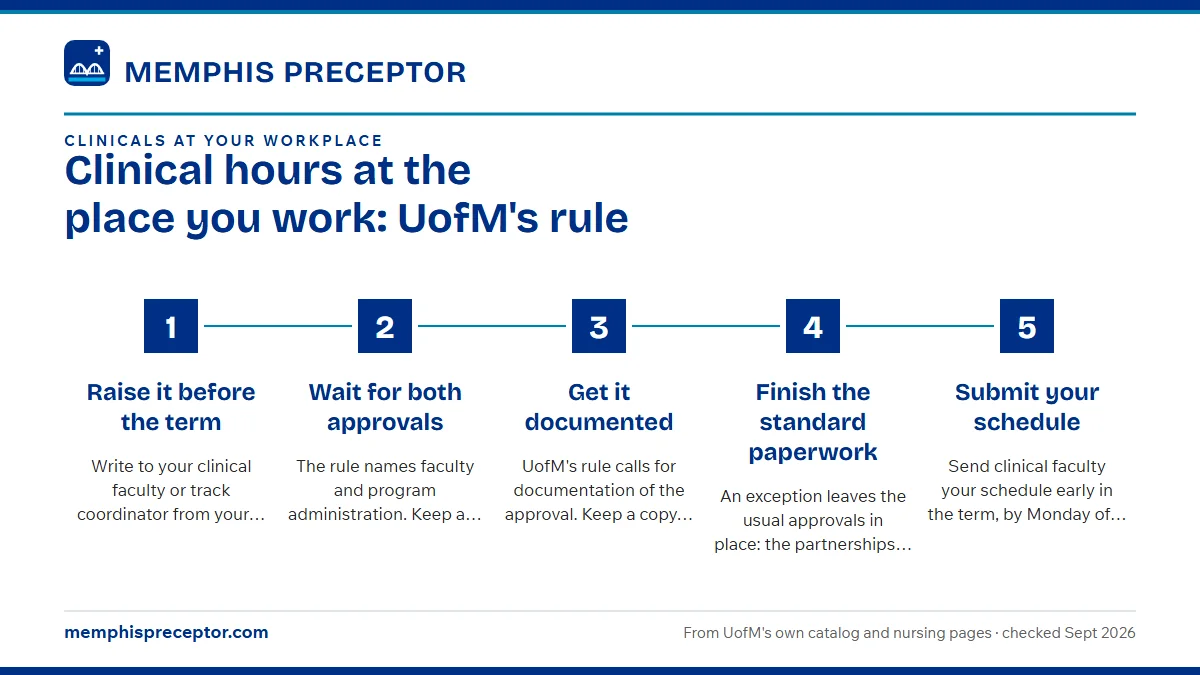
- Raise it before the termWrite to your clinical faculty or track coordinator from your umMail account, which LCON treats as the official channel. Describe the site, your role there and why the circumstances are compelling.
- Wait for both approvalsThe rule names faculty and program administration. Keep a non-employer option moving until both have said yes.
- Get it documentedUofM's rule calls for documentation of the approval. Keep a copy with your clinical records so the decision is easy to point to later.
- Finish the standard paperworkAn exception leaves the usual approvals in place: the partnerships office still signs the preceptor agreement form ahead of day one, and your Complio and myClinicalExchange items still have to clear for the site.
- Submit your scheduleSend clinical faculty your schedule early in the term, by Monday of week two, exactly as for any other placement.
Log no hours at your workplace until the documented approval exists. UofM treats clinical practice without prior approval from clinical faculty as grounds for dismissal from the course.
BSN students: the same question from another angle
Traditional and Accelerated BSN students are assigned their clinical placements by UofM, so the workplace question looks different for them. The Bulletin warns that a BSN student who is denied placement at a facility for any reason, prior employment included, may be required to withdraw from the program.
The same passage offers a way to lower that risk. Students who raise such concerns before clinical assignments are made may be considered for reassignment to another site, if one is available. If you once worked for a Memphis or Jackson facility and parted on difficult terms, bring it up with the college before assignments go out. The Traditional BSN guide explains how BSN placements run.
Where we fit: a strong site that is not your job
Whether or not UofM steps in on your placement, we secure a preceptor and site that satisfy its rules, and for most working nurses that means a site beyond the employer. We search close to where you live, match the setting your course names, and test every candidate against your track's rotation rules, from the NP-precepted rotation all three NP tracks require to the family practice setting FNP students need.
Before the semester opens, we assemble what the agreement form asks about the preceptor, from licensure to board certification to practice setting, and keep your Complio and myClinicalExchange items on track. If you are asking UofM for a workplace exception, we build the outside option in parallel, so a no from faculty leaves you with a ready alternative instead of a blank page. Your clinical faculty make the final call, and the placement we put in front of them is complete and built to UofM's rules from the start.
Tell us your track, your employer and your first practicum term through the contact form. If the search has already stalled, see the steps for students who can't find a preceptor.
Questions UofM students ask
Can my UofM NP clinical hours happen at the hospital that employs me?
Only as an exception. UofM's default keeps practicum hours away from any clinical site where you are currently employed. If compelling circumstances apply, faculty and program administration can approve the placement, and the approval has to be documented. Plan a non-employer site in parallel so a decision against the exception still leaves you somewhere to go.
What counts as compelling circumstances at UofM?
UofM leaves the phrase undefined and offers no examples. The people who approve the exception, faculty and program administration, decide each case on its facts. Put your situation in writing, explain why an outside site will not work, and ask your clinical faculty or track coordinator how your track usually handles these requests.
Does the rule cover another hospital in my employer's health system?
UofM's wording refers to a clinical site where you are currently employed and stops there. It does not say whether a sister hospital or clinic in the same system counts. Check with your clinical faculty before planning around a site in your employer's network, and get the answer in writing from your UofM email.
What if I start a job at my clinical site during the semester?
Tell your clinical faculty right away. The rule turns on where you are currently employed, so a new job can change how your placement is viewed. If a different site becomes necessary, both clinical faculty and the clinical coordinator have to approve the move in writing, as the site changes guide explains.
Does the workplace rule apply to Nursing Education and Leadership immersions?
The rule appears in the Bulletin's MSN clinical policies and names no single track, so read it as covering immersion hours as well, then confirm with the track coordinator who covers Education and Leadership. One more wrinkle for Education students: their residency cannot go back to a site they have already used.
Related pages
Last checked 2026-09-27
We check these pages against UofM's 2026-27 catalog, the LCON Academic Bulletin, program pages and licensure disclosures. Your clinical faculty and your plan of study have the final word.
Whether UofM helps or you start alone, we find the preceptor.
Tell us your UofM concentration, your next practicum and the town you train near. We find preceptors and sites that fit the course and prepare what the preceptor agreement form needs, early enough for approval before the first clinical day.
- Preceptors matched to the rotation rules: an NP preceptor, family practice for FNP, inpatient and critical care for AG-ACNP
- License, certification and site details ready for the preceptor agreement form, with your Complio items in order
- Across the Mid-South, Tennessee and the states UofM serves
Start your placement plan
Your concentration, your town and your next clinical semester is all we need to begin.