Precepting a University of Memphis nursing student
Teaching a UofM student brings a licensed, clearance-ready nurse into your practice for a defined course with clear expectations. We take on the legwork around it: matching a student whose course fits your setting, preparing the agreement details and building a schedule that works for your clinic and for UofM. Here is what the role involves.
Tell us about your practice
Share your specialty, location and the days you could teach. A placement advisor follows up.
Who you would teach
The students we match are enrolled at UofM's Loewenberg College of Nursing, most of them in the online MSN tracks for family, adult-gerontology acute care and psychiatric-mental health nurse practitioners, or in the graduate certificates that mirror them. Others are MSN Nursing Education or Nursing Leadership students completing immersion hours.
Every one of them is already a registered nurse, holding an unrestricted RN license issued by Tennessee or by an approved state where their clinical work happens, and keeping it current for the length of the program. AG-ACNP students also arrive with the equivalent of two years of full-time adult critical care or emergency department nursing within the three years before admission.
Coursework is online, while each practicum happens near the student's home. That is why a student living close to your practice can learn from you without relocating.
The preceptor agreement form
Every UofM graduate placement starts with the preceptor agreement form. It must be filled in and then cleared by the college's partnerships office, formally the Office of Community Partnerships and Practice, ahead of the student's opening clinical day. Nothing clinical happens until that approval is in place.
We collect what the form asks about in advance: your license and board certification, a description of your practice, and the site's location and type of care. Your part becomes a short review of details already assembled. Our agreement form guide describes the approval step from the student's side.
Tennessee sets its own baseline for preceptors. Board of Nursing rule 1000-01-.11 expects a preceptor's license to be unencumbered, valid where the teaching takes place and at least equal to the credential the student is pursuing, and it expects demonstrated competence in the clinical area. Schools track preceptor licenses through Nursys e-Notify. The Tennessee NP practice guide explains the state's framework.
The practicum courses
Each practicum is a specific UofM course with its own focus, so the student we bring you is taking a course that fits what your practice does.
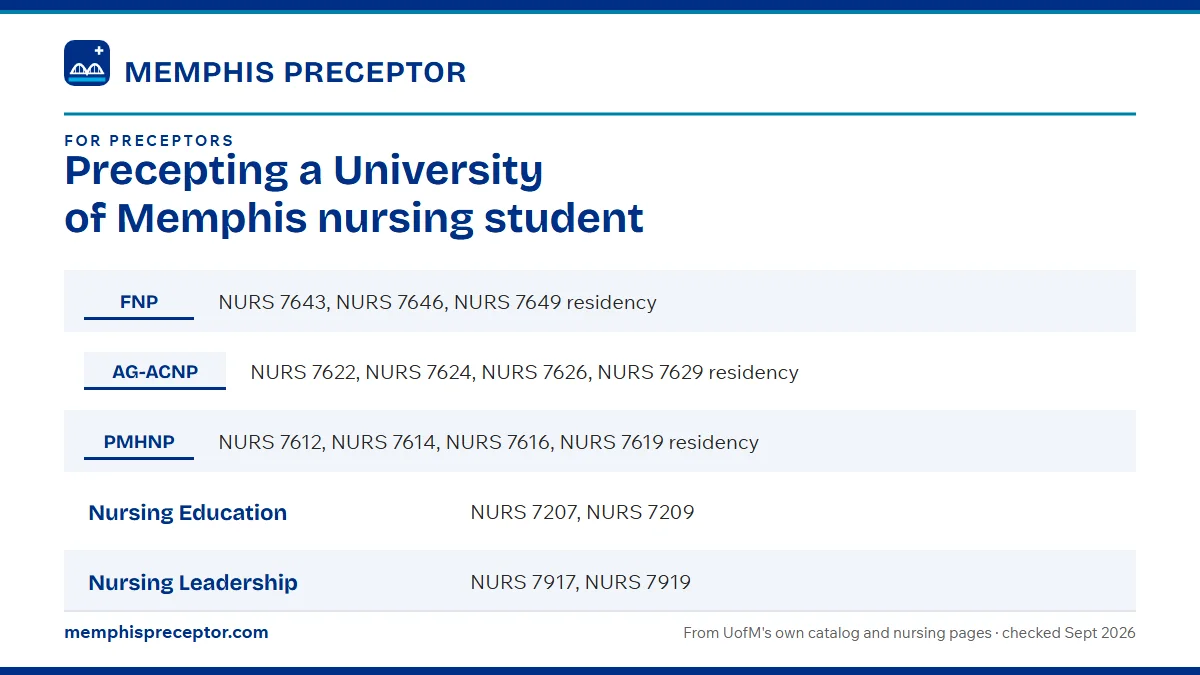
| Track | Practicum courses | Setting focus |
|---|---|---|
| FNP | NURS 7643, NURS 7646, NURS 7649 residency | Acute and chronic primary care across the lifespan; residency in family practice or internal medicine |
| AG-ACNP | NURS 7622, NURS 7624, NURS 7626, NURS 7629 residency | Practice that includes inpatient care, in clinic, hospital or critical care settings |
| PMHNP | NURS 7612, NURS 7614, NURS 7616, NURS 7619 residency | Assessment and diagnosis, then outpatient and inpatient psychiatric settings |
| Nursing Education | NURS 7207, NURS 7209 | Nurse educator immersion, 120 and then 240 hours |
| Nursing Leadership | NURS 7917, NURS 7919 | Nurse leader immersion under a qualified preceptor, 120 and then 240 hours |
Course-by-course detail is in our guides to the FNP practicums, AG-ACNP practicums and PMHNP practicums.
Rotation rules that shape each match
UofM's Academic Bulletin sets rules about who precepts what, and we match students with them in mind. In every NP track, a nurse practitioner has to precept at least one of the student's rotations. FNP students must also spend a rotation in family practice, and their residency belongs in family practice or internal medicine.
Within the final NP residency, a student can devote a maximum of 60 hours to specialty practice, once the Track Coordinator agrees. An NP student is allowed back at a former site for the residency, so a practice that teaches a student well in one course may be asked to host that student again. Nursing Education students are the exception: their residency has to happen somewhere they have not trained before. The full set is in our rotation rules guide.
Schedules, evaluation and faculty support
The student works on a schedule you help shape. UofM asks the student to give clinical faculty a schedule by Monday of the second week of the semester and to send any change in writing a week ahead. A course's hours spread across at least seven weeks, and university breaks and holidays are skipped unless program faculty make other arrangements.
You are never teaching alone. Tennessee's rule says student clinical experiences, including precepted ones, are directed by nursing faculty, with the preceptor as an adjunct to that teaching. UofM's Student Clinical Evaluation Tool is used by faculty and preceptors to rate the student's performance, the clinical faculty member's final visit serves as a performance evaluation, and both faculty and preceptor must judge the student competent for the course to be complete.
A student who arrives ready
UofM students clear a demanding checklist before they reach your door. The college tracks it in DISA Complio: an annual criminal background check, a drug screen dated no more than 30 days ahead of every fall or spring practicum, AHA BLS, immunizations with annual TB and influenza, and proof of health insurance. Where a site uses HealthStream myClinicalExchange, the student completes its orientation modules and document uploads there. UofM also requires renewal dates that run past the end of the placement, so every item stays valid for the whole time the student is with you.
Professional malpractice coverage for students is obtained and maintained by the college, as our malpractice coverage guide explains. In clinic, UofM students wear a white lab coat over street clothes with their UofM nametag and clinical ID, and they handle their own transportation.
How we make precepting easy
Clinicians teach with us because the practical side is handled. You get one placement advisor as your contact, a student whose course genuinely fits your practice, agreement details prepared before you are asked to look at anything, and a schedule planned around the days your clinic can host. You decide how often you teach and which courses suit your setting, and your placement advisor stays in touch through the term so any question about the student's course reaches the right person quickly.
Precepting also shapes the next generation of nurse practitioners serving communities you know, from Memphis neighborhoods to rural West Tennessee, where HRSA lists primary care shortage areas. To offer your practice, use the form on this page and choose "I'm a preceptor (not a student)", or reach us through the contact page.
Questions UofM students ask
What does UofM need from me as a preceptor?
Your credentials and practice information for the preceptor agreement form, which needs sign-off from the college's partnerships office before the student starts. During the course, you supervise the student's clinical work, give input through UofM's Student Clinical Evaluation Tool and join the judgment of competence with the clinical faculty.
How many hours would a student spend with me each week?
That is set by the course and by your schedule. Each practicum carries a fixed total, UofM requires the hours to stretch across at least seven weeks, and clinical faculty approve the final schedule. We plan the weekly pattern with you first, so the student's calendar fits your clinic rather than the other way around.
Can I precept a UofM student outside Tennessee?
Often, yes. UofM's MSN students complete practicums where they live, and some live in other states. Tennessee's rule looks at the license you hold where the teaching happens, and other states write their own requirements. Tell us your state, and your placement advisor confirms how UofM's state rules affect a match before anything is arranged.
Is the student covered by malpractice insurance?
Yes. UofM's Academic Bulletin lists current professional malpractice insurance among the graduate clinical requirements and states that the college obtains and maintains it. Students also carry their own health insurance, and their clearance items, from the background check to immunizations, are tracked in DISA Complio before any clinical day begins.
Can I host the same student for more than one course?
Frequently, yes. UofM allows NP students to finish their residency at a practice where they trained earlier, so a practice that fits more than one course can watch a student grow across the sequence. Nursing Education students take their residency to a fresh site. We plan multi-course arrangements with you at the start.
Related pages
Last checked 2026-09-27
We check these pages against UofM's 2026-27 catalog, the LCON Academic Bulletin, program pages and licensure disclosures. Your clinical faculty and your plan of study have the final word.
Whether UofM helps or you start alone, we find the preceptor.
Tell us your UofM concentration, your next practicum and the town you train near. We find preceptors and sites that fit the course and prepare what the preceptor agreement form needs, early enough for approval before the first clinical day.
- Preceptors matched to the rotation rules: an NP preceptor, family practice for FNP, inpatient and critical care for AG-ACNP
- License, certification and site details ready for the preceptor agreement form, with your Complio items in order
- Across the Mid-South, Tennessee and the states UofM serves
Start your placement plan
Your concentration, your town and your next clinical semester is all we need to begin.