Who does what in UofM's clinical process
Several offices and titles at the Loewenberg College of Nursing touch your clinicals, and each one approves something different. Preceptor agreement forms go to the Office of Community Partnerships and Practice for sign-off, your schedule and each clinical day need clinical faculty approval, and track coordinators rule on residency specialty hours. This page maps the work by title, so each question lands with the right office.
Get your placement plan
Tell us your UofM program and where you live. A placement advisor replies with the preceptor and site options that fit your UofM course.
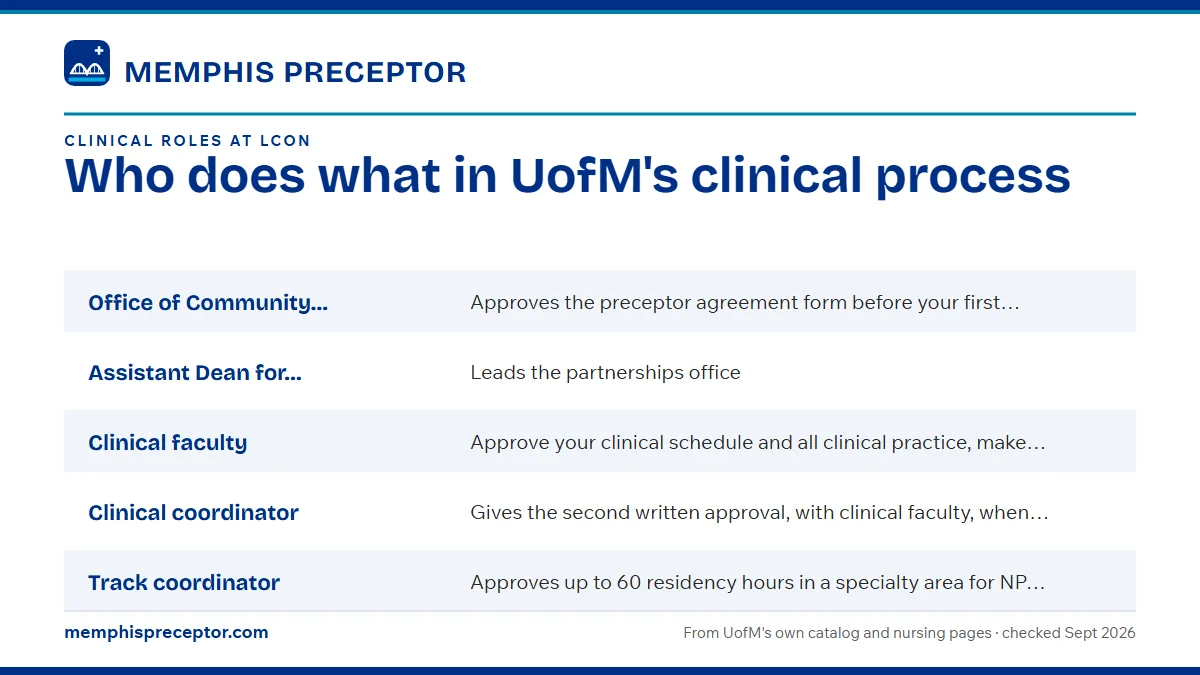
The approval map at a glance
UofM spreads clinical decisions across several titles, and the Academic Bulletin and faculty handbook give each one a defined job. Here is how they line up for an MSN or graduate certificate student.
| Title or office | What it handles in your clinicals |
|---|---|
| Office of Community Partnerships and Practice | Approves the preceptor agreement form before your first clinical day, reviews vaccine waiver requests, and manages LCON's relationships with clinical partners |
| Assistant Dean for Community Partnerships and Practice | Leads the partnerships office |
| Clinical faculty | Approve your clinical schedule and all clinical practice, make the final clinical visit, and judge competence together with your preceptor |
| Clinical coordinator | Gives the second written approval, with clinical faculty, when your clinical site changes |
| Track coordinator | Approves up to 60 residency hours in a specialty area for NP students and works with the partnerships office on preceptor and site concerns |
| Faculty and program administration | Approve and document a placement at your current employer when compelling circumstances prevail |
| MSN Program Director | Handles late adds and late drops, joins approvals for late or extra withdrawals, and receives clinical release notes after an incident |
| Faculty Advisor | Advises every MSN student each semester and must be seen after an unsatisfactory clinical grade or any grade below B |
| Preceptor | Supervises your practice at the site and helps evaluate you with the Student Clinical Evaluation Tool |
The Office of Community Partnerships and Practice
This office is the approval point for the paper side of a placement. No clinical day happens until it has signed off on your completed preceptor agreement form, and the same office weighs vaccine waiver requests case by case. Waivers for Tdap, MMR or varicella are off the table, a limit UofM ties to Tennessee law and its affiliation agreements.
Approval authority for the agreement form has moved over the years. Earlier documents, including the 2020-21 MSN handbook and the spring 2025 Bulletin, sent the form to the clinical coordinator. The AY25-26 and AY26-27 Bulletins name the partnerships office, so advice passed down from older cohorts may point to the wrong title. The preceptor agreement form guide covers the form itself.
UofM's MSN required documents page also names a Director for Clinical Affairs in its waiver review. Follow the route your current documents page shows, and see the immunizations and BLS guide for the full list of health items.
Clinical faculty and the clinical coordinator
Once a practicum starts, your clinical faculty member is the title you will work with most. Clinical faculty review the clinical schedule you send them by Monday of week two, approve clinical practice in advance, and carry out the final clinical visit, which UofM counts as a clinical performance evaluation. Finishing the course also takes a finding of competence from two people: your clinical faculty member and your preceptor.
The clinical coordinator appears in the Bulletin as the second signature on a change of clinical site, next to clinical faculty. UofM's public pages give no fuller description of the graduate clinical coordinator's role, so ask your clinical faculty who holds that title for your course before a site change ever comes up. The schedule and site changes guide explains how those approvals work.
Planned absences take their own path. They need the Practicum Leave of Absence Request Form, handed to your clinical instructor a week or more beforehand, and approval is not automatic.
Track coordinators, the MSN Program Director and the deans
UofM has a track coordinator for FNP, one for AG-ACNP, one for PMHNP, and one shared by Nursing Education and Nursing Leadership. For NP students, the track coordinator's most familiar sign-off is the specialty allowance, which lets as many as 60 residency-semester hours go to a specialty area when approved beforehand. The faculty handbook also has track coordinators work with the partnerships office on preceptor, community and clinical site concerns and compliance. The rotation rules cover the allowance in detail.
The MSN Program Director handles registration exceptions: a late add with the instructor's approval, a drop after the drop date for circumstances beyond your control, and, together with the Senior Associate Dean for Academic Affairs, late withdrawals and any withdrawal beyond the one course an MSN student may withdraw from across the plan of study. After a clinical incident, the director also receives the clinical release notes.
A grade appeal starts with course faculty and can climb to the Senior Associate Dean for Academic Affairs, the Dean and, last, the Graduate School. UofM's own listings also show an Acting Associate Dean for Academic Affairs, so confirm which office is handling your appeal. An Incomplete extension needs signatures from the instructor and the department chair, plus the Vice Provost for Graduate Programs for graduate students. See grades and progression.
Advising, questions and everyday help
Each MSN student is assigned a Faculty Advisor and should be advised every semester, with at least two meetings a term, often in small groups. You also owe your advisor a visit after a failing or unsatisfactory clinical grade, or after any grade under a B. The college sends no reminders, so booking those meetings is up to you. Advisors record their notes in Navigate or UMDegree.
UofM also lists a Student Academic Coordinator for Graduate Programs as a contact for graduate students, and LCON's Scrub Hub ticket form takes questions and concerns for the college. Problems with your university accounts go to the umTech Service Desk. Formal messages from LCON arrive through your UofM email, and advising runs through umMail rather than a personal or work account, so send clinical questions from there too. The student systems guide explains each tool.
Titles for BSN students and outside programs
BSN placements run through a different set of titles. UofM's faculty handbook gives the Director of Undergraduate Programs the duty to place students in appropriate clinical groups, and the college also lists an Undergraduate Clinical Placement Coordinator and an LCON Academic Services Coordinator. In the Traditional and Accelerated BSN, UofM assigns the clinical placements; the Traditional BSN guide explains how that works.
LCON hosts learners from other schools as well. A nurse enrolled in a non-LCON graduate nursing program who needs a preceptor must contact the Director for Clinical Education before approaching any LCON faculty member. Department chairs lead LCON's departments of Acute, Chronic, and Continuing Care Science and of Family, Community, and Health System Science.
Where the preceptor fits, and where we fit
Your preceptor supervises your practice at the site, rates your performance with the Student Clinical Evaluation Tool alongside faculty, and joins clinical faculty in deciding whether you are competent to complete the course. Tennessee's Board of Nursing rules treat preceptors as support for faculty-directed clinical learning rather than a replacement for it, and call for a preceptor licensed at the level you are training for or higher. Tennessee NP practice and preceptors goes further.
Whatever role UofM plays in your placement, we search out a preceptor and site that match its rules, with a process organized around the titles above. Your preceptor's credentials, certification and practice details are ready for the agreement form the partnerships office approves. The schedule you hand clinical faculty respects the rotation rules and the seven-week minimum. Your Complio and myClinicalExchange items are in order before the site asks. Every approval stays with UofM's faculty and offices; what we prepare reaches them complete and built to the rules from the start.
Questions UofM students ask
Who approves my preceptor at UofM?
Approval runs through several titles. The partnerships office signs off on the preceptor agreement form before clinical starts, clinical faculty then approve your clinical schedule and each clinical day, and the track coordinator decides if an NP student asks to spend some final residency hours in a specialty area.
Who is the clinical coordinator in UofM's MSN program?
The Bulletin names a clinical coordinator as the second approver, with clinical faculty, when a clinical site changes. UofM does not publish who fills that role for each course or track. Ask your clinical faculty or track coordinator early, so you know who signs if your site ever has to change.
Who should I contact first when a clinical problem comes up?
Start with your clinical faculty for anything touching your schedule, your site or a clinical day. Questions about the preceptor agreement form or a vaccine waiver go to the partnerships office, and progression questions go to your Faculty Advisor. Write from your umMail account so there is an official record.
Who signs off on clinical hours at my own workplace?
By default, practicum hours stay off your employer's site. If the circumstances are compelling, an exception needs sign-off from both faculty and program administration, and UofM expects it on paper. The workplace clinicals guide walks through the wording and the open questions.
Does my preceptor decide my practicum grade?
Not alone. Faculty and preceptors both use the Student Clinical Evaluation Tool, the final clinical visit by clinical faculty counts as a performance evaluation, and completing the course takes a competence finding from both clinical faculty and preceptor. Final grades follow the course syllabus, and every practicum requires a B or better.
Related pages
Last checked 2026-09-27
We check these pages against UofM's 2026-27 catalog, the LCON Academic Bulletin, program pages and licensure disclosures. Your clinical faculty and your plan of study have the final word.
Whether UofM helps or you start alone, we find the preceptor.
Tell us your UofM concentration, your next practicum and the town you train near. We find preceptors and sites that fit the course and prepare what the preceptor agreement form needs, early enough for approval before the first clinical day.
- Preceptors matched to the rotation rules: an NP preceptor, family practice for FNP, inpatient and critical care for AG-ACNP
- License, certification and site details ready for the preceptor agreement form, with your Complio items in order
- Across the Mid-South, Tennessee and the states UofM serves
Start your placement plan
Your concentration, your town and your next clinical semester is all we need to begin.